AI-powered legal document review is exactly what it sounds like: using artificial intelligence to analyze, sort, and pull key information out of legal documents—fast. It’s technology designed to take over the tedious, manual work of sifting through dense text, freeing up legal professionals to focus on strategy and analysis instead of grunt work.
The End of Manual Review as We Know It
Picture this: you’re facing a merger with thousands of contracts to review and a deadline that feels impossible. That exact scenario, once a nightmare for legal teams, is where AI document review completely changes the game. It’s not here to replace lawyers. It’s a powerful, tireless assistant that makes them better at their jobs.
This technology automates the painstaking process of combing through dense legalese, pinpointing critical clauses, and flagging potential risks. It fundamentally shifts the work from manual drudgery to strategic thinking, letting legal experts apply their judgment where it actually matters.
From Manual Sifting to Intelligent Searching
Think of the old process like looking for a needle in a haystack by hand—slow, expensive, and riddled with opportunities for error. An AI legal document review platform is like having a powerful magnet that instantly pulls exactly what you need to the surface. It's a leap in efficiency that is fundamentally changing legal workflows.
Instead of spending weeks buried in paper, legal professionals can now:
- Accelerate Due Diligence: Fly through thousands of documents in M&A deals or real estate transactions.
- Improve Accuracy: Slash the risk of human error and fatigue that plagues high-volume review projects.
- Control Costs: Dramatically reduce the billable hours tied to manual document examination.
The real win isn't just speed; it’s about reallocating expert human capital. When AI handles the monotonous "what" and "where," legal professionals can dedicate their full attention to the strategic "why" and "what if."
This shift allows legal teams to be more proactive. Instead of being buried in documents, they can get ahead of issues, advise clients with deeper insight, and contribute more meaningfully to business outcomes. A recent survey backs this up, showing that 77% of legal professionals using AI are using it specifically for document review, cementing its role as a core workflow tool.
In this guide, we’ll break down how this technology actually works, explore its practical applications, and show you how to implement it to gain a decisive advantage.
How AI Reads and Understands Legal Language
You don't need a computer science degree to get how AI legal review works. At its heart, the technology learns to "read" and make sense of legal text through two core ideas: Natural Language Processing (NLP) and Machine Learning (ML).
Think of it this way: NLP is how the AI learns to read the words, and ML is how it builds experience.
NLP is what allows a computer to understand the nuance and intent behind human language—something notoriously tricky in legal documents. A simple phrase like "shall indemnify" carries a totally different weight than "may indemnify," and a good NLP model is trained to spot those critical distinctions, much like a seasoned paralegal learns to see them over years of practice.
If NLP is the ability to read, then Machine Learning is the process of getting courtroom (or boardroom) experience. The AI analyzes millions of executed agreements, clauses, and filings to recognize patterns. It’s a lot like how a junior associate learns to spot a problematic clause after seeing hundreds of examples. The more data the AI sees, the better it gets at knowing what’s standard, what’s risky, and what’s missing entirely.
This isn't just about matching keywords; it’s about developing a form of comprehension.
The chart below shows how this evolution frees up legal professionals. The goal isn’t to replace human review but to handle the heavy lifting so lawyers can focus on strategy and judgment.
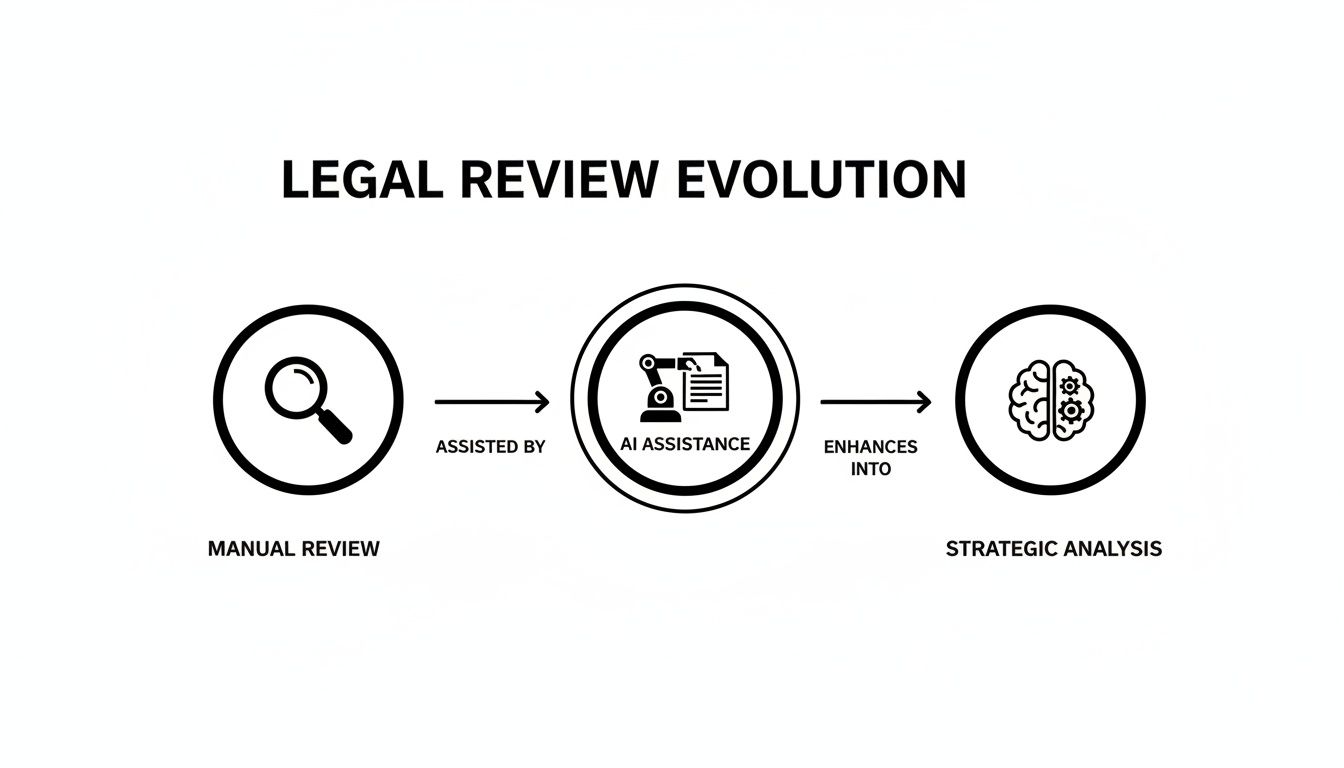
As you can see, AI serves as a powerful bridge, moving the work from manual slog to high-level strategic analysis.
From Concepts to Concrete Functions
So, what does the AI actually do? This combination of NLP and ML isn't just theory; it enables the software to perform specific, high-value tasks that make an immediate impact on the review process.
Here are the three main jobs an AI performs during document analysis:
- Clause Detection and Classification: The AI can instantly find every single instance of a specific clause type, even across thousands of documents. Imagine you need to locate every "Change of Control" clause in a dataset for an M&A deal. A task that would take a human reviewer days to complete with perfect accuracy, the AI can do in minutes.
- Data Extraction: This is about pulling specific data points out of dense documents and organizing them. The AI can grab key dates (like contract expiration or renewal deadlines), party names, financial figures, and governing law jurisdictions, then drop them neatly into a spreadsheet or database. Automatically.
- Risk Scoring and Anomaly Detection: By comparing clauses in a new document to the massive dataset it was trained on, the AI can flag language that deviates from the norm. It might highlight a limitation of liability clause that is unusually one-sided or an auto-renewal term that lacks a clear notice period, assigning it a risk score to grab a human reviewer's attention right away.
By automating these foundational tasks, AI lets legal professionals start their work from a position of knowledge. Instead of spending hours just searching for information, they begin their review with the critical data and potential risks already surfaced and organized.
This capability is why we're seeing such a rapid shift in the industry. In fact, over 3,000 law firms worldwide have already moved to AI-driven platforms for document review. The need to manage massive volumes of documents efficiently is undeniable.
Recent studies even show that advanced models like ChatGPT-4 achieved passing-level performance in three out of four business law domains. Crucially, 68% of its contract-related responses were deemed practically viable by legal experts. Discover more about these AI legal review findings and their implications.
AI Document Review in Real-World Scenarios

Understanding the tech is one thing, but seeing it in action is another. The real value of an AI legal document review platform comes alive when you apply it to the high-stakes, time-sensitive work legal teams face every single day. Let's move from theory to practice and see how this technology is actually changing legal workflows.
From corporate law to litigation, AI isn’t just a nice-to-have—it’s a practical tool that delivers results. It turns overwhelming data rooms into manageable datasets and chaotic discovery into a structured, searchable pool of evidence.
Powering Mergers and Acquisitions Due Diligence
Think about the classic due diligence crunch. A corporate legal team has to review thousands of contracts from a target company before a major acquisition. The old way? Deploy an army of junior associates to a data room for weeks, manually reading every single agreement to find those "needles in a haystack"—problematic clauses, change-of-control provisions, or unusual liabilities.
AI completely flips this script. An AI platform can ingest the entire data room—thousands of contracts, NDAs, and partnership agreements—and analyze them in hours, not weeks.
The system can instantly:
- Identify and flag all change-of-control clauses that could be triggered by the acquisition.
- Extract key financial obligations and summarize them for a senior lawyer's quick review.
- Pinpoint non-standard indemnity clauses or risky termination rights.
This frees up the legal team to focus on strategic analysis and negotiation, armed with a complete picture of the target's contractual landscape from day one.
Revolutionizing Litigation and eDiscovery
Litigation is drowning in data. A single case can involve millions of emails, texts, and internal documents that all need to be reviewed for relevance and privilege—a process we call eDiscovery. Doing this by hand is not only astronomically expensive but also riddled with human error, which can have serious legal consequences.
AI-powered eDiscovery has become an essential tool for litigation teams. Instead of manually tagging documents one by one, lawyers use AI to rapidly sift through huge volumes of electronically stored information (ESI). The tech uses predictive coding, learning from a small sample of human-reviewed documents to apply that same logic across the entire dataset, pushing the most relevant files to the top of the pile.
This dramatically cuts down eDiscovery timelines. In fact, some in-house legal teams have seen up to 50% faster closures on legal requests. This is a game-changer during litigation, where professionals can be buried under millions of files. It’s no surprise that a recent survey showed 46% of firms believe eDiscovery is where AI will have the biggest impact over the next five years. You can learn more about how AI is accelerating the eDiscovery process and see why this shift is happening so quickly.
Streamlining In-House Contract Management
For in-house legal departments, managing the lifecycle of hundreds or thousands of active contracts is a constant headache. It’s far too easy for key dates—renewals, price escalations, termination notices—to get lost in the shuffle, leading to missed opportunities or costly auto-renewals.
An AI legal document review system acts as a vigilant, automated contract manager.
By continuously monitoring a company's contract portfolio, the AI ensures no critical date or obligation is ever missed. It functions as a centralized intelligence layer that provides complete visibility and control over the company's contractual commitments.
Imagine a startup’s General Counsel who needs to vet a dozen new vendor agreements under a tight deadline. Instead of a multi-day manual review, she can run them through an AI platform in a single afternoon. The AI instantly flags non-standard terms, compares them against the company's approved playbook, and pulls out key business terms for the procurement team. A small legal team can suddenly operate with the efficiency of a much larger one.
The table below breaks down how these applications look across different legal needs, showing the direct benefit in each scenario.
AI Document Review Applications Across Legal Needs
| Use Case | Primary Task Automated by AI | Key Benefit |
|---|---|---|
| M&A Due Diligence | Identifying risky clauses and obligations across thousands of target company contracts. | Drastically reduces review time from weeks to hours, allowing lawyers to focus on strategic risk analysis. |
| Litigation & eDiscovery | Sifting through millions of documents to find relevant and privileged information. | Accelerates discovery, lowers costs, and minimizes human error in document tagging. |
| Contract Lifecycle Management | Extracting key dates, obligations, and non-standard terms from active contracts. | Prevents missed renewals and provides a centralized, searchable view of all contractual commitments. |
| Regulatory Compliance | Screening documents against specific regulatory requirements (like GDPR or CCPA). | Ensures consistent compliance checks and quickly identifies potential violations at scale. |
| Real Estate | Reviewing leases to extract critical data like rent schedules, options, and CAM clauses. | Speeds up portfolio analysis and lease abstraction, making property management more efficient. |
As these real-world applications show, AI is much more than a buzzword in the legal field. It represents a fundamental shift in how legal work gets done, empowering professionals to work faster, smarter, and with greater strategic focus.
Weighing the Benefits and Navigating the Risks
Adopting AI legal document review isn't a silver bullet. You have to go in with a clear-eyed view of both its incredible advantages and its potential pitfalls. The technology offers massive gains in speed, accuracy, and cost, but it's not without challenges. Understanding that balance is the key to using AI responsibly and effectively.
On one side of the scale, the benefits are almost impossible to ignore. AI tools can analyze thousands of pages in the time it takes a human to review a single contract, slashing project timelines for things like due diligence or eDiscovery. That efficiency translates directly into huge cost savings by cutting down the billable hours spent on tedious, manual work.
And then there's accuracy. A person reviewing their hundredth contract of the day is far more likely to miss a subtle but critical detail than a machine is. The AI performs with the same precision on document one thousand as it did on document one, eliminating the human fatigue factor.
The Undeniable Advantages of AI Review
The real value here is built on measurable improvements to core legal workflows. These aren't just tiny gains; they represent a fundamental shift in how legal work gets done.
Let's break down the key benefits:
- Massive Speed Gains: AI can process and analyze millions of pages of text in hours, not months. This accelerates everything from litigation discovery to M&A due diligence, giving legal teams a critical time advantage.
- Significant Cost Reduction: By automating the most labor-intensive parts of document review, firms can slash project costs. This lets them offer more competitive pricing or reallocate that budget to higher-value strategic work.
- Enhanced Accuracy and Consistency: AI systems apply the exact same criteria to every document, every single time. This consistency minimizes the risk of human error, overlooked clauses, or inconsistent tagging that can plague large-scale manual reviews.
- Deeper Insights: Beyond just a simple review, AI can spot trends, patterns, and anomalies across vast document sets that would be impossible for a human to see. This can uncover hidden risks or even strategic opportunities.
The industry is catching on fast. While a projected 79% of legal professionals are expected to use AI for tasks like document review, a surprising 44% of law firms still operate without any formal AI policies. This data points to a swift but uneven adoption, where the technology's power is outpacing the governance needed to manage it. You can learn more about why law firms need a realistic AI policy to get ahead of this curve.
Addressing the Real Risks and Concerns
Of course, with this kind of power comes the need for serious caution. The risks tied to AI legal document review are real, and you have to manage them proactively. Handing over critical tasks to an algorithm requires a solid framework of trust and verification.
The biggest concern is simply over-relying on the tech. If a legal team trusts an AI's output without question, they risk missing the subtle nuances or context-dependent details that a machine might not grasp. This is where the "human-in-the-loop" model becomes absolutely essential.
AI should be viewed as a powerful first-pass reviewer and analytical tool, not the final arbiter. The technology empowers professional judgment; it doesn't replace it. Human expertise is required to validate the AI's findings, interpret nuanced language, and make the final strategic decisions.
Another major risk is the phenomenon of AI "hallucinations," where the model generates plausible-sounding but factually incorrect information. While this is less common in specialized legal AI than in general-purpose models like ChatGPT, the risk is still there. A well-designed system fights this by grounding its analysis in the source documents and providing clear citations, letting human reviewers quickly verify its outputs.
Finally, and most importantly, data security and client confidentiality are paramount. Uploading sensitive legal documents to a third-party platform demands robust security protocols, end-to-end encryption, and clear data governance policies. Choosing a provider that makes these a top priority is non-negotiable. By understanding these risks from the start, legal teams can implement the right safeguards and workflows to get all the benefits of AI while maintaining the highest standards of professional responsibility.
How to Choose the Right AI Solution for Your Firm

With a flood of new AI tools hitting the market, picking the right one for your firm can feel overwhelming. The secret is to look past the marketing hype and run a structured evaluation. Finding the right AI legal document review solution isn't about chasing the "best" product—it's about finding the right partner for your specific contracts, workflows, and risk tolerance.
This decision needs a framework that balances raw technical power with day-to-day usability. After all, a brilliant tool that’s too complicated for your team to actually use is just as useless as a simple one that can't do the job. A good place to start is by focusing on four core pillars: accuracy, integration, security, and scalability.
Define Your Core Requirements
Before you even watch a single demo, you have to know what problem you’re trying to solve.
Are you trying to accelerate M&A due diligence? Streamline eDiscovery? Or get a handle on your firm’s massive contract portfolio? Each of these use cases demands different strengths from an AI system.
Create a checklist of your absolute must-haves. This simple step will help you weed out the wrong options fast and focus your energy on platforms that actually fit your goals. Think about the documents you handle most. Are they complex commercial agreements, messy litigation filings, or standardized NDAs? The best AI is one trained on data that looks like yours.
Evaluate Accuracy and Reliability
Accuracy is the bedrock of any legal AI tool. But a vendor’s accuracy claims are meaningless without proof. The single most important question you can ask is: "How does your model perform on my documents?" A system trained on one type of legal agreement might stumble when it sees another.
Insist on a pilot project or a proof-of-concept using a sample set of your own documents. This is the only way to get a true read on the tool's real-world performance. During the trial, scrutinize the AI's output. Does it correctly identify key clauses? Is the data extraction precise?
Remember, the goal of AI isn’t 100% autonomous perfection. It’s to provide a reliable, auditable first pass that a human expert can then verify and refine. A good tool is honest about its limitations and makes human oversight easy.
Look for features that show you why the AI made a certain recommendation. That kind of transparency builds trust and helps your team use the tool more effectively. A platform that just spits out an answer without showing its work is a black box you can't build a practice on.
Assess Integration and Usability
The most advanced AI in the world is worthless if it breaks your existing workflow. A new tool should feel like a natural extension of how you already work, not another frustrating hurdle. Look for platforms that integrate smoothly with the software you already rely on, like your document management system (DMS) or case management software.
Usability is just as important. The interface should be intuitive enough that your team can get up to speed with minimal training. According to one recent survey, 35% of professionals who haven't adopted AI are unsure what kind of work it could even be used for. A clean, user-friendly design tears down that barrier by making the tool's value obvious from the start.
Ask for a live demo and watch the user experience like a hawk. How many clicks does it take to do a common task? Can you easily customize reports? A smooth, friction-free experience is critical for getting your whole firm on board and seeing a real return on your investment. The best platforms are clearly designed with the end-user—the busy legal professional—in mind.
To help you get started, here's a practical checklist for comparing different platforms head-to-head.
Evaluation Checklist for AI Document Review Tools
| Evaluation Criteria | Key Questions to Ask | Why It Matters |
|---|---|---|
| Accuracy & Performance | Can we run a pilot with our own documents? What are your accuracy metrics for our specific document types (e.g., MSAs, NDAs)? | Generic accuracy claims are useless. Real-world performance on your own contracts is the only metric that counts for reliable first-pass reviews. |
| Use Case Alignment | Is the platform designed for litigation, M&A due diligence, or contract management? Can it handle our specific clause types and risk profiles? | A tool built for eDiscovery may lack the nuanced clause intelligence needed for complex contract negotiations. The best fit aligns with your primary workflow. |
| Integration Capabilities | Does it integrate with our DMS (e.g., NetDocuments, iManage), CMS, or cloud storage (e.g., Google Drive, OneDrive)? Is there an API? | Seamless integration prevents workflow disruption and data silos. Without it, you're just adding another manual step for your team to manage. |
| Usability & Adoption | How intuitive is the user interface? What is the typical training time for a new user? Can our team get started without extensive onboarding? | A complex tool won't get used. A low barrier to entry ensures your team actually adopts the software, which is critical for achieving a positive ROI. |
| Security & Compliance | Where is our data hosted and processed? What are your data retention and deletion policies? Are you SOC 2, ISO 27001, or GDPR compliant? | Legal documents contain highly sensitive and privileged information. Weak security is a non-starter and exposes your firm and clients to unacceptable risk. |
| Explainability & Trust | Can the AI show why it flagged a certain clause or assigned a risk score? Can we see the underlying logic or data it used? | A "black box" AI is a liability. Explainable AI builds trust and allows legal professionals to verify outputs, maintaining professional responsibility. |
| Customization & Control | Can we create our own playbooks, clause libraries, and risk-scoring rules? How easily can we train the model on our specific requirements? | Off-the-shelf models may not fit your firm's unique standards. Customization ensures the AI aligns with your negotiation positions and risk appetite. |
| Support & Partnership | What does your customer support model look like? Do you offer dedicated legal engineers or success managers to help with implementation? | The right vendor acts as a partner. Strong support ensures you can resolve issues quickly and maximize the value you get from the platform. |
Choosing an AI partner is a big decision, but with a structured approach, you can cut through the noise and find a solution that genuinely empowers your team.
Your Roadmap for Implementing AI Document Review
Bringing AI into your legal practice isn’t about flipping a switch. The most successful rollouts are thoughtful and gradual, designed to build confidence and prove value every step of the way. It’s a journey, not a disruptive overhaul.
Think big, but start small. Trying to deploy a new system firm-wide without testing the waters is a classic recipe for confusion and pushback. A better approach? A targeted pilot project that serves as a low-risk, high-reward first step to show what AI legal document review can really do.
Start with a Pilot Project
First things first: pick a specific, high-impact use case. This could be a single M&A due diligence review or even just a batch of standard commercial contracts that your team handles constantly. The idea is to create a controlled environment where you can see the technology’s impact firsthand.
A well-run pilot project does a few critical things for you:
- It proves the concept. You get concrete, undeniable evidence of how AI saves time and boosts accuracy on your team’s actual work.
- It creates internal champions. The lawyers and paralegals involved in a successful pilot become your most credible advocates for wider adoption.
- It reveals workflow gaps. You’ll quickly see where your current processes need tweaks to get the most out of the tool.
The best way to think about implementation is to treat the AI like a new team member, not just another piece of software. It has a specific role, needs to be brought up to speed, and must be woven into the team's collaborative fabric to actually be effective.
This initial phase is all about learning. The insights you gain here will shape your entire strategy for a broader rollout and help you sidestep the common pitfalls.
Define Clear Goals and Success Metrics
Before you even start the pilot, you need to know what winning looks like. Vague goals like “improving efficiency” are not good enough. You need specific, measurable metrics to calculate the return on investment (ROI). This data is what builds the business case for a larger investment down the road.
Get your benchmarks straight by asking these questions:
- How many hours does this type of review take us manually?
- What’s our estimated cost per document for this work right now?
- What’s the typical error or oversight rate in our current process?
With these baselines in place, you can measure the AI's performance against your existing methods. This shifts the conversation from a subjective debate about new tech to an objective, data-driven decision. After all, a recent report found that 53% of organizations are already seeing a positive ROI from their AI tools—a number you can absolutely aim to replicate.
Empower Your Team with Training
This last step is the most important one: empower your people. The fanciest technology is worthless if no one knows how to use it—or worse, doesn't want to. Good training isn't about showing people which buttons to click. It’s about shifting mindsets.
Focus on building confidence. Explain how the AI is there to augment their expertise, not threaten their jobs. You need to establish new, AI-assisted workflows that draw a clear line between where the technology’s work ends and where human judgment takes over.
This is how you get the most out of your investment while making it clear that expert human oversight is, and always will be, the final authority on legal matters.
Common Questions About AI in Legal Review
As AI becomes a real part of daily legal work, it’s natural to have practical questions about how it works and what it means for your practice. Let’s tackle some of the most common ones legal teams are asking.
These aren't just theoretical debates. They're about real-world concerns—from data security to billing—that come up the moment you consider using this technology.
Is My Client Data Safe with an AI Platform?
This is always the first—and most critical—question. The only acceptable answer is an absolute yes. Any reputable AI platform is built on a foundation of serious security. That means things like end-to-end encryption to protect your data whether it's being sent or just sitting on a server.
When you're looking at a tool, ask the provider to show you their security measures. Look for certifications like SOC 2 or ISO 27001. Your client’s confidentiality is the one thing you can’t compromise on, so any partner has to prove they take data protection as seriously as you do.
Will AI Replace Lawyers or Paralegals?
Nope. The overwhelming consensus is that AI is here to augment human expertise, not replace it. In a recent survey, 85% of legal professionals said they see AI changing their roles and requiring new skills, not getting rid of jobs altogether.
Think of AI as a force multiplier. It takes on the high-volume, repetitive work—like the first pass on a thousand documents or finding every single indemnification clause—so legal professionals can focus on strategic advice, tricky negotiations, and client counseling. It handles the "what" so you can focus on the "why" and "what's next."
The goal is to free up legal teams to do more of the high-value work that a machine could never do.
How Does AI Impact Billing Models?
This is where things get interesting. AI brings a level of efficiency that directly challenges the traditional billable hour. When you can slash the time spent on document review, you suddenly have the freedom to explore things like flat fees or even subscription models.
This shift can be a huge competitive advantage. Firms using AI can give clients more predictable pricing and much faster results, which adds up to a better client experience. In fact, about 43% of legal professionals expect to see the billable hour decline over the next five years, and AI's productivity boost is a major reason why. It’s a chance to tie your billing to the value you create, not just the hours you log.
Ready to see how an AI-powered workflow combined with a tamper-evident trust layer can bring clarity and integrity to your legal documents? Legal Chain provides the tools to draft, review, and verify contracts with confidence. Explore our platform today.
Composed with Outrank
