So, what exactly is legal document review software? Think of it less like a digital filing cabinet and more like an expert analytical partner. It's technology that uses artificial intelligence to help you analyze, manage, and understand legal documents—without the soul-crushing manual work.
Instead of spending hours or days poring over dense contracts, this software acts as a second set of eyes, instantly flagging risks, spotting inconsistencies, and speeding up the entire review process from start to finish.
Moving Beyond Manual Document Review
Ever tried to find a single typo in a 100-page report by reading it line by line? That’s the old way of doing legal document review. For legal teams, startup founders, and small businesses, it’s a high-stakes, manual grind where one missed clause can lead to serious financial or legal trouble.
Let's be honest, modern business moves at a pace that manual review just can’t keep up with. The sheer volume of contracts, NDAs, and compliance paperwork can bury even the most diligent teams. This is where legal document review software comes in, turning an overwhelming administrative burden into a real strategic advantage.
The Shift to Intelligent Analysis
The explosive growth in this space tells the whole story. The global legal document management software market hit USD 2.49 billion in 2024 and is projected to skyrocket to USD 9.67 billion by 2034. Why? Because professionals are under immense pressure to handle more documents, faster, without compromising on quality. You can dive deeper into these trends over at Zion Market Research.
This technology isn't just about going paperless. It’s about embedding real intelligence into your workflow. By automating the most repetitive parts of the review, the software frees you up for what really matters: strategic thinking, tough negotiations, and high-value legal work. It empowers you to manage your legal obligations with confidence, not anxiety.
The core value is simple: it lets you focus on the meaning of the document, not just the words. The software handles the tedious work of cross-referencing clauses and checking for deviations, so you can apply your expertise to what truly matters.
To really see the difference, it helps to put the old and new ways side-by-side. The gap is stark.
Manual Review vs Software-Assisted Review
Here’s a quick comparison that highlights just how much things have changed.
| Aspect | Manual Document Review | Software-Assisted Review |
|---|---|---|
| Speed | Painfully slow, often taking days or weeks for complex documents. | Radically faster, cutting review times by up to 90% in some cases. |
| Accuracy | Prone to human error, fatigue, and oversight, leading to missed risks. | Highly accurate, using AI to consistently flag issues and inconsistencies. |
| Cost | High costs tied to billable hours spent on tedious, low-value review tasks. | Lower operational costs by minimizing manual labor and preventing expensive errors. |
| Risk Analysis | Entirely dependent on the individual reviewer's experience and attention to detail. | Provides deep, automated risk analysis, highlighting non-standard or problematic clauses. |
| Strategic Value | Focus is on just getting the task done, leaving little time for strategic insight. | Frees up professionals to focus on negotiation, strategy, and client relationships. |
The takeaway is clear: software doesn't replace legal expertise; it amplifies it. By handling the rote work, it allows human intelligence to be applied where it has the most impact.
What’s Under the Hood? Core Capabilities of Legal Review Software
To really get why this software matters, you have to look past the surface. These platforms aren't just fancy word processors; they're sophisticated engines built to analyze, track, and secure legal documents with a level of precision that’s tough to achieve manually. Each feature works with the others to give you both smart insights and unshakable confidence in your contracts.
Think of these capabilities not as a simple checklist, but as an interconnected system. The whole point is to move beyond just reading a document to truly understanding its consequences, catching the details a busy human eye might skim over.
The core benefits really boil down to three things: making the process faster, more accurate, and easier to analyze.
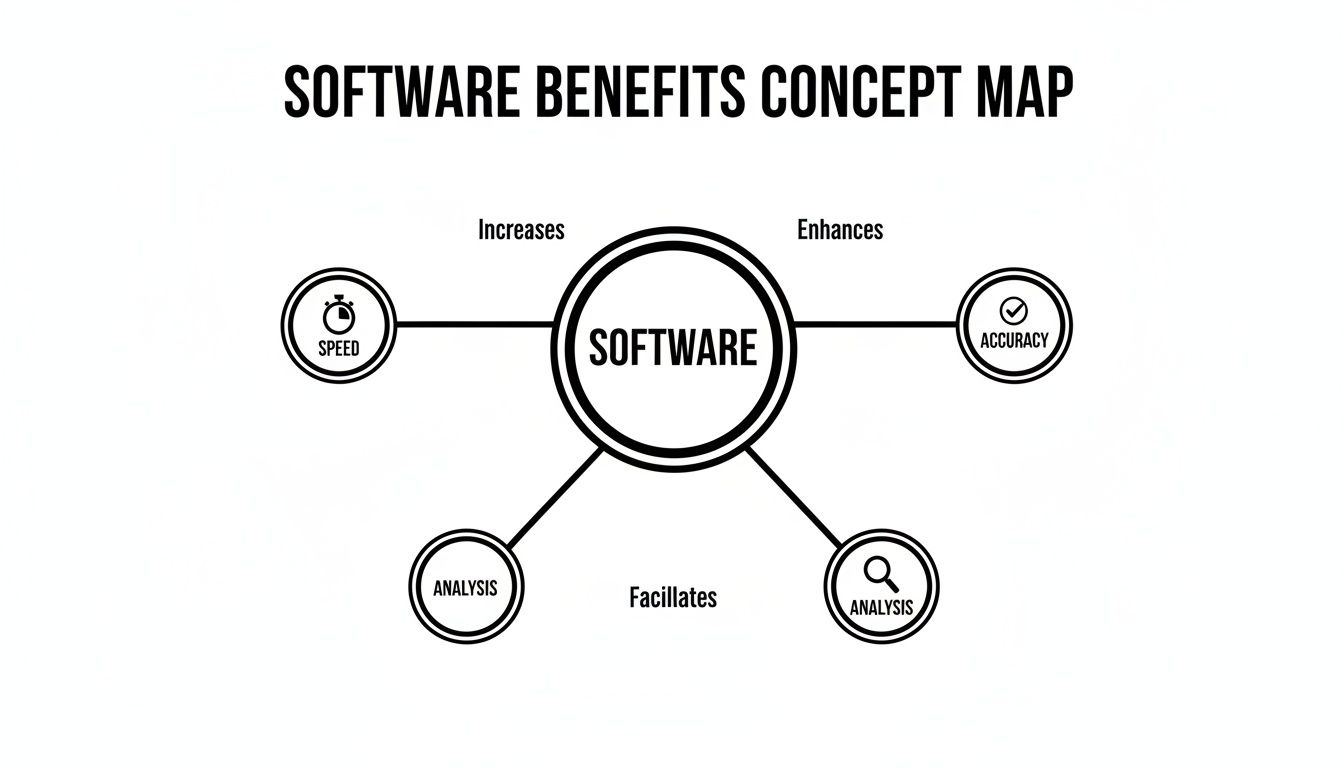
This setup shows how the software acts as a central hub, improving efficiency, cutting down on errors, and providing deeper contractual insights all at once.
AI Clause Analysis
At the heart of any modern review tool is AI Clause Analysis. It’s like having a seasoned paralegal on call 24/7 who has already seen millions of contracts. It doesn't just scan for keywords; it actually understands legal concepts and context.
For instance, when you upload a new vendor agreement, the AI can instantly compare the indemnification clause to your company's approved version. If it spots language that shifts too much liability onto your shoulders, it flags it right away. It can even suggest better, safer wording pulled from best practices or your own internal playbook.
This single feature is a game-changer for keeping things consistent and under control, especially when you’re juggling hundreds or even thousands of active agreements.
Intelligent Redlining and Version Control
Negotiations get messy. We’ve all been there—multiple drafts, comments flying in from different people, and total confusion over which version is the right one. This is where Intelligent Redlining and Version Control saves the day.
Think of it as a time machine for your documents. Every single edit, comment, and approval is logged automatically, creating a clean, easy-to-follow history of how the document evolved. You can see who changed what, when they did it, and even why.
This isn't just about tracking edits. It's about creating a clear, indisputable record of the negotiation process. If a dispute arises months later, you have a complete history of intent at your fingertips.
This completely eliminates that classic headache of figuring out which file is the "final_final_v2" version. The system maintains a single source of truth, so everyone is always working from the most current draft while all previous iterations are securely archived for backup.
Automated Risk Detection
Let’s be honest, most contractual risks aren’t hiding in obviously aggressive language. They’re buried in subtle ambiguities, weird phrasing, or critical omissions. Automated Risk Detection is your early-warning system, scanning for these hidden liabilities before they blow up.
This goes way beyond a simple keyword search. Using Natural Language Processing (NLP), the software can identify potentially toxic phrases, like:
- Ambiguous Obligations: Clauses with fuzzy responsibilities or deadlines that are just begging for a future dispute.
- Unfavorable Terms: One-sided payment schedules, termination rights, or liability caps that are heavily stacked against you.
- Missing Clauses: The complete absence of crucial protections, like confidentiality or data security provisions.
For example, the software might flag a services agreement for lacking a clear "Force Majeure" clause, alerting you to a major vulnerability. It helps you fix weaknesses proactively instead of doing damage control later. It’s no wonder that, according to one report, 77% of legal professionals are now using AI tools for document review to get a better handle on risk.
Verifiable Audit Trails
In a world of digital files, how do you prove a document is authentic and hasn't been messed with? A Verifiable Audit Trail provides a digital fingerprint for your agreements, ensuring the contract you signed is the exact same one being enforced.
This is where platforms like Legal Chain really shine. By anchoring document metadata—like cryptographic hashes and timestamps—to a secure ledger, it creates a tamper-evident record. Any unauthorized change to the document would be immediately obvious because the data wouldn't match the anchored proof.
This is critical for:
- Regulatory Compliance: Easily providing proof of document integrity during an audit.
- Dispute Resolution: Proving that a contract has not been altered after it was signed.
- High-Stakes Transactions: Guaranteeing the finality and authenticity of your most important agreements.
Ultimately, these core capabilities are designed to work together. The AI finds the risks, version control tracks the negotiations, and the audit trail guarantees the final document’s integrity. They transform legal review from a manual chore into a powerful, strategic advantage.
Who Benefits Most From This Technology?

You might think this kind of software is only for massive corporate legal departments with bottomless budgets. But the reality is, its value extends to a much wider circle of professionals. Anyone who feels the constant squeeze of limited time and resources is discovering these tools aren't a luxury—they're a lifeline.
The biggest impact is felt by people wearing multiple hats. Think startup founders, nonprofit leaders, and solo operators. For them, the ability to quickly grasp what's in a document, spot risks, and stay compliant can make or break a deal.
Let’s walk through a few real-world examples to see how this plays out.
The Startup General Counsel Navigating Growth
Imagine you’re the only in-house lawyer at a tech startup that’s about to close its Series A funding. The pressure is on. You’re staring down a data room packed with hundreds of due diligence documents—shareholder agreements, IP assignments, you name it. On top of that, a complex investor term sheet just landed in your inbox.
Going through every single document by hand would create a massive bottleneck, possibly delaying the very funding your company needs to survive and scale. This is where legal document review software shines.
Instead of a painful line-by-line review, you can:
- Instantly scan all due diligence files, flagging any missing signatures, conflicting dates, or clauses that don't match your standards.
- Compare the investor agreement against your company's preferred terms, immediately highlighting any weird liquidation preferences or board composition language.
- Check for consistency across the entire deal package, ensuring key terms are uniform from one document to the next.
The result? You give investors the assurances they need in record time, close the funding round weeks ahead of schedule, and get back to business, all while drastically reducing the chance of a costly mistake.
The Freelancer Protecting Their Business
Now, let's switch gears. You're a freelance graphic designer, and a big new client just sent over their standard 15-page independent contractor agreement. It's a wall of dense legal text. Hiring a lawyer for every new contract would eat up your profits, but signing blindly feels like walking a tightrope without a net.
This is where document review software becomes your secret weapon. You upload the contract and get an immediate, high-level analysis of the clauses that matter most to you.
The software acts as your first line of defense, empowering you to spot potential issues and ask informed questions before you sign. It demystifies the language that could otherwise put you at a disadvantage.
The AI might flag a nasty intellectual property clause that gives the client ownership of your entire portfolio, or a payment term that lets them wait 90 days to pay you. Armed with that insight, you can negotiate for better terms with confidence, protecting your work and your cash flow. It’s a small step that prevents huge headaches down the road.
The Nonprofit Manager Ensuring Compliance
Finally, picture yourself as an operations manager at a mid-sized nonprofit. You juggle dozens of grant agreements and vendor contracts every year, each with its own strict compliance rules and reporting deadlines. One slip-up could jeopardize funding or put the organization in breach of contract.
The legal tech market has exploded to around $30 billion, and it's no longer just about storing documents. The new platforms are active intelligence hubs—perfect for organizations that need solid governance and audit trails. For a deeper dive into these market trends, check out this detailed analysis.
With legal document review software, you can build a standardized process. The platform automatically scans every grant for required reporting language and confirms vendor contracts include the right liability clauses. This creates a transparent, auditable record for your board and stakeholders, proving due diligence and protecting the organization's mission-critical funding.
How to Choose the Right Legal Document Review Software
Picking the right software for your team can feel like a massive decision, but it doesn't have to be a shot in the dark. A little structure goes a long way in cutting through the marketing hype to find a tool that actually makes your life easier. This isn't just about cool features; it's about finding a partner that gets your workflow, respects your security needs, and fits your budget.
Let's break down the must-ask questions for any vendor you're considering.
H3: Security and Data Privacy
This is non-negotiable. Before you even look at a demo, you need absolute confidence that your client data and sensitive documents are locked down. A breach isn't just an inconvenience; it can be a disaster for your reputation and your clients. Your first questions should always be about their security posture.
Here’s what to look for:
- Encryption: Is your data encrypted both in transit (while it’s being uploaded) and at rest (sitting on their servers)? The gold standard here is AES-256, the same level of encryption used by banks.
- Access Controls: How granular can you get with user permissions? You need to control exactly who can view, edit, or download what, right down to the document level.
- Compliance Certifications: Does the vendor hold certifications like SOC 2, GDPR, or CCPA? These aren't just acronyms; they're proof that an independent third party has audited their security practices.
Don’t just take their word for it. Ask to see the paperwork or audit reports that back up their claims.
H3: Seamless Integrations
The best software in the world is useless if it forces you to live in a dozen different tabs. A tool that constantly makes you switch between apps is a productivity killer. You're looking for something that feels like a natural extension of how you already work.
Think about your team's daily toolkit. Do you live in Google Drive, Microsoft 365, or Salesforce? The software you choose should plug right into those systems. A great integration means you can pull a contract directly from cloud storage or sync data with your CRM without a clunky export-import dance.
The real question is simple: Will this make my job easier or just add another complicated step? A truly valuable tool should reduce clicks, not create them.
This kind of efficiency is only getting more important. The eDiscovery market—a close cousin to document review—is projected to grow from $15.16 billion in 2025 to $25.2 billion by 2035, a huge jump driven by the sheer volume of digital information legal teams now have to wrangle. You can read more about what’s driving this trend at The Business Research Company.
H3: AI Accuracy and Training
Here’s a hard truth: not all AI is created equal. A generic AI model trained on the entire internet might be great at writing poems, but it will probably choke on the nuances of your industry-specific contracts. The real magic of legal AI comes down to its training data and how well it adapts to your documents.
When you’re talking to a vendor, get specific about their AI:
- How was the AI model trained? Was it fed a steady diet of legal documents relevant to your field, or just random web pages?
- Can the AI be customized? Can you teach it to recognize your company’s standard clauses or flag the unique risks you worry about most?
- How does it handle ambiguity? The best way to test this is to give them one of your own tricky documents and watch how the AI performs in a live demo.
You’re looking for an AI that works like a sharp junior associate, not a glorified search bar.
Choosing the right software is a process of careful evaluation. The checklist below is designed to give you a structured way to compare vendors and make sure you're asking the right questions from the start.
Software Evaluation Checklist
| Evaluation Category | Key Question to Ask | Why It Matters |
|---|---|---|
| Security & Privacy | Can you provide your SOC 2 report and details on your encryption standards (in transit and at rest)? | This provides third-party validation that your confidential data will be protected against breaches. |
| Integrations | Does your platform offer native integrations with our core systems (e.g., Microsoft 365, Google Drive, Salesforce)? | A tool that doesn't fit your existing workflow will create friction and lower adoption rates across the team. |
| AI Accuracy | Can we test the AI with our own documents to see how it handles our specific clauses and contract types? | Generic AI models often fail on nuanced legal language. Real-world testing is the only way to validate performance. |
| Workflow Fit | Can you walk us through how your software would handle our end-to-end contract review process, from intake to signature? | You need to see if the tool's design philosophy matches your team's actual day-to-day operations. |
| Pricing Model | What is the total cost of ownership, including all fees for users, storage, support, and integrations? | Hidden fees can turn a good investment into a budget problem. Clarity is essential for predictable costs. |
By working through these questions, you can move beyond the sales pitch and focus on how a tool will perform in the real world for your team.
H3: Transparent Pricing
Finally, the price has to make sense. The pricing model should be clear, predictable, and directly tied to the value you're getting. Hidden fees, surprise overages, and confusing tiers are red flags that can turn a great tool into a financial headache.
Demand absolute clarity on the total cost of ownership. Ask the vendor directly: are there extra charges for adding users, for data storage, for premium customer support, or for key integrations? A trustworthy provider will give you a straightforward pricing plan that lets you budget effectively and know exactly what you’re paying for. Simple, flat-rate models are often much easier to manage than ones with a dozen different variables.
Getting the Most Out of Your Software (And Seeing Real ROI)

Buying legal document review software is the easy part. The real work—and the real payoff—comes from getting your team to actually use it. Without a smart plan to weave the tool into your daily grind, even the best platform can turn into expensive shelfware. A good implementation strategy is what turns cool features into money saved and risks avoided.
The trick is to start small and build from there. Forget the disruptive, company-wide rollout. Instead, think pilot program. This lets you prove the software’s value on a manageable scale, iron out the kinks, and create a few internal fans who can sell it to the rest of the team.
Start with a Pilot Program
First things first: pick a single, high-volume document that’s a known bottleneck. For a lot of companies, that’s the Non-Disclosure Agreement (NDA). NDAs are constant, fairly standard, and essential to getting business done, which makes them the perfect testing ground.
Get a small team focused on mastering the software for just this one task. As they get faster, track the time saved and errors caught. This gives you a powerful internal case study that makes a much better argument for a wider rollout than any sales deck ever could.
A successful pilot isn't just about testing the software; it’s about building confidence. When other people see a review that used to take an hour now takes ten minutes, they’ll be lining up to get access.
This phased approach takes the pressure off and lets your team learn without feeling overwhelmed. It’s the single best way to make sure your legal document review software becomes a can’t-live-without-it part of your workflow.
Create Clear Guidelines and Training
Adoption lives or dies on clarity. Your team has to know exactly when to use the new tool and how. Forget dense manuals. Create simple, practical training materials—think short video clips or one-page cheat sheets that cover the main tasks.
Then, bake the software right into your standard operating procedures. Create a clear rule, like, "All third-party sales contracts must run through the software before legal sees them." This removes any gray areas and makes the tool a required, helpful step instead of an optional chore. It’s a proven strategy—a recent report found that 53% of organizations are already seeing ROI from AI investments, and that’s because they put a structure around it.
Making the ROI Tangible
At the end of the day, a tool is only as good as the results it delivers. Abstract benefits are nice, but hard numbers showing time and money saved are what really prove the software’s worth.
Just look at what’s possible:
- Faster Sales Cycles: One tech startup used review software to standardize how it analyzed sales contracts. The result? They cut their average deal cycle in half and started booking revenue faster.
- Risk Mitigation: A small business dodged a potential $10,000 liability after the software flagged a funky indemnification clause buried on page 12 of a vendor agreement.
- Administrative Savings: A nonprofit streamlined its grant reporting process, saving over 40 hours of administrative work a year. That’s a full week of work they could put back into their mission.
These aren’t just hypotheticals. This is how legal document review software stops being a cost and starts being a strategic asset that saves you time, money, and a whole lot of stress.
Where AI and Trust Finally Meet in Legal Tech
As artificial intelligence gets smarter, the next big leap for legal technology isn't just about speed. It’s about trust. The real future lies in combining powerful AI analysis with absolute, verifiable proof that the document you're reviewing is the right one.
After all, what good is a perfect contract analysis if you can't be certain you're looking at the authentic, final version? This is the critical challenge that the next wave of legal tech is built to solve—creating an unshakable, transparent history for every single agreement.
Creating an Unbreakable Document History
The core idea is to give each document a permanent, auditable history, borrowing a concept from the technology that secures financial transactions: blockchain. By creating a unique digital fingerprint—a cryptographic hash—for a document at a specific point in time, you create a permanent, tamper-evident record.
Any change, no matter how tiny, would be instantly obvious. This approach directly tackles the growing anxiety around digital document fraud and unauthorized edits in a world where files are constantly shared and copied. It’s a move beyond simple version control into the realm of provable integrity.
The goal is to fuse AI's analytical power with a foundation of cryptographic proof. This lets you not only understand what a contract says but also trust that the digital file itself is secure and untampered with.
The Role of Platforms like Legal Chain
This is exactly where platforms like Legal Chain are raising the bar. By weaving AI-powered review together with an optional, blockchain-style integrity layer, the system delivers confidence from start to finish. You get the efficiency of AI alongside a verifiable audit trail that confirms a document’s history and authenticity.
This two-part approach offers a complete solution:
- AI for Intelligence: It rapidly analyzes text, spots risks, and checks your clauses against established standards, turning review from a chore into a strategic advantage.
- Integrity Layer for Trust: It anchors document metadata on a secure ledger, providing a permanent, tamper-evident record that can be independently verified by anyone, at any time.
A New Standard for Legal Operations
Ultimately, modern legal document review software is becoming essential for anyone who needs efficiency, accuracy, and security. It empowers you to do more than just manage agreements; it enables you to trust them completely.
Looking ahead, the platforms that will lead the industry are the ones that deliver both sophisticated insights and undeniable proof. This combination isn't a luxury anymore—it's a fundamental part of modern legal work, ensuring every contract is not just understood, but truly trustworthy.
Still Have Questions?
You're not alone. When you're talking about something as critical as legal documents, it’s natural to have questions. Here are a few of the most common ones we hear, with straight-to-the-point answers.
How Does the AI Actually Read a Legal Document?
It’s less about reading and more about pattern recognition on a massive scale. Think of the AI as a paralegal who has reviewed millions of contracts. It uses a technology called Natural Language Processing (NLP) to identify patterns, legal terms, and entire clauses—not just as words, but in context.
For example, the software has seen countless "Indemnification" clauses. It learns what a standard version looks like, what’s market, and what’s aggressive. When it sees one in your document, it instantly compares it against that massive dataset to flag language that’s unusual, one-sided, or deviates from your company’s playbook.
So, Does This Mean I Don’t Need My Lawyer Anymore?
Absolutely not. It's best to see this software as a powerful assistant that makes your lawyer more effective, not a replacement for their judgment. The technology is built to handle the tedious, time-consuming grunt work of sifting through pages and flagging potential issues.
This frees up legal professionals to focus on what they do best:
- Providing strategic advice and nuanced judgment.
- Handling complex negotiations.
- Making critical decisions based on years of experience.
Always, always consult a licensed attorney for actual legal advice. This kind of tool just gets the low-value work out of the way so your lawyer can focus on the high-value strategy that matters.
The software takes care of the “what”—finding risky clauses and deviations. This lets your legal counsel focus on the “why”—interpreting what those risks mean for your business.
How Do I Know My Confidential Data Is Safe?
This is the big one, and for good reason. Data security is non-negotiable for any reputable platform. Your sensitive legal documents are protected with multiple layers of security, often called bank-grade measures. This should be a top-of-the-list criterion when you're choosing a provider.
Look for a few key security features as a baseline:
- End-to-End Encryption: This scrambles your data during upload and storage, making it unreadable to anyone without the right keys.
- Strict Access Controls: You should be able to define exactly who on your team can view, edit, or download specific documents. No exceptions.
- Regulatory Compliance: Any serious platform will adhere to strict data privacy laws like GDPR and CCPA, ensuring your data is handled responsibly.
The best systems take it a step further, providing a verifiable, tamper-evident audit trail. It’s an extra layer of integrity that proves your documents are authentic and haven't been altered behind the scenes.
Ready to bring AI-powered analysis and verifiable trust to your legal documents? Discover how Legal Chain can make your review process faster, smarter, and more secure. Explore our features and start your free trial today at https://legalcha.in.
Enhanced by Outrank app
