Contracts are the lifeblood of any organization, yet managing them often feels like navigating a maze of manual processes, hidden risks, and costly delays. A disorganized approach doesn't just waste time; it exposes your business to compliance failures, financial leakage, and unnecessary disputes. Effective contract management is no longer an administrative chore but a strategic imperative that directly impacts your bottom line.
This guide provides a prioritized roundup of 10 essential contract management best practices designed to transform your process from a reactive bottleneck into a proactive, value-generating engine. We will move beyond theory to provide concrete, actionable strategies for every stage of the contract lifecycle, from initial drafting and negotiation to post-signature monitoring and renewal. You will learn how to build a robust framework that enhances efficiency, mitigates risk, and unlocks valuable business intelligence hidden within your agreements.
Each best practice includes practical implementation steps and shows how to operationalize these concepts effectively. We will explore how modern tools, including Legal Chain's AI-powered clause intelligence, automated review highlights, and tamper-evident trust layer, can help you implement these strategies. This article is your blueprint for streamlining operations and gaining a critical competitive edge. Let's dive into the practices that turn good contract governance into great business performance.
1. Centralized Contract Repository with Version Control
One of the most foundational contract management best practices is establishing a centralized repository. This is a single, secure, and organized system that serves as the "single source of truth" for all company agreements. It eliminates the chaos of contracts scattered across email inboxes, local hard drives, and various cloud storage accounts, ensuring everyone works from the most current document.
A centralized repository isn't just about storage; it's about control and accessibility. It provides a complete, auditable history of every contract's lifecycle. Stakeholders can track every modification, see who made changes, and understand when those changes occurred. This systematic approach drastically reduces the risk of referencing outdated terms, minimizes disputes over contract versions, and creates a clear chain of accountability.
Why It's a Top Practice
Without centralization, locating a specific contract becomes a time-consuming and frustrating task. Key personnel may leave the company, taking critical contract knowledge with them. By implementing a central repository, you create a permanent, accessible corporate memory that protects your organization from knowledge loss and operational delays. For example, systems like Ironclad provide a dedicated workspace for contracts, while fintech startups often use blockchain-enabled repositories to guarantee document integrity.
How to Implement This Practice
- Establish Naming Conventions: Create and enforce a clear, consistent naming convention and folder structure (e.g.,
[Counterparty]_[ContractType]_[EffectiveDate]). This makes manual browsing intuitive. - Utilize Metadata Tagging: Tag each contract with key metadata like contract type, value, renewal date, and governing law. This turns your repository into a searchable database, allowing for quick filtering and reporting.
- Set Access Controls: Implement role-based access permissions. Ensure that only authorized team members can view, edit, or approve sensitive agreements, protecting confidential information.
- Integrate for Immutability: For maximum security, integrate your repository with a trust layer. Legal Chain’s platform anchors cryptographic hashes of each version to a blockchain, creating a tamper-evident, permanent record that proves a document's integrity at a specific point in time.
2. Structured Clause Intelligence and Template Standardization
Another critical contract management best practice is moving away from ad-hoc drafting and embracing standardized templates and a structured clause library. This involves creating a pre-approved repository of contract clauses and complete agreement templates that reflect your organization's legal standards, risk tolerance, and commercial preferences. Instead of starting from scratch, teams can build compliant, consistent agreements quickly and confidently.
This approach transforms contract creation from an art into a science. It embeds institutional knowledge directly into your drafting process, ensuring that every new agreement benefits from past negotiations and complies with current legal requirements. By standardizing language for common provisions like indemnification, confidentiality, and limitation of liability, you reduce drafting time, minimize human error, and strengthen your negotiating position.
Why It's a Top Practice
Drafting contracts from a blank page is inefficient and introduces unnecessary risk. Each new draft can contain subtle variations that deviate from company policy, leading to inconsistent obligations and increased exposure. A standardized template and clause library ensures uniformity and control. For instance, tech companies like Vanta use standardized security clauses across all customer agreements to maintain consistent compliance, while Y Combinator’s publicly available SAFE (Simple Agreement for Future Equity) templates have standardized early-stage startup financing.
How to Implement This Practice
- Build Collaboratively: Involve legal, sales, finance, and compliance teams when creating and approving standard templates and clauses. This ensures the language is legally sound, commercially viable, and operationally practical.
- Organize by Use Case: Structure your library with distinct templates for different agreement types, such as NDAs, MSAs, SLAs, and employment contracts. Tag individual clauses by function (e.g.,
Liability,DataPrivacy,PaymentTerms). - Leverage AI for Drafting: Use tools that integrate directly with your clause library. Legal Chain’s AI-guided drafting can auto-populate approved templates and intelligently suggest relevant clauses, ensuring no critical terms are missed.
- Establish a Review Cadence: Regularly audit and update your templates to reflect new regulations, market standards, and lessons learned from recent negotiations. Document the rationale behind key clauses to guide future drafters.
3. Risk-Based Contract Analysis and Scoring
Not all contracts carry the same level of risk, yet many organizations review them with a one-size-fits-all approach. A more strategic and efficient method is risk-based contract analysis and scoring. This involves systematically assessing agreements against predefined risk factors, such as financial exposure, liability caps, compliance obligations, and intellectual property implications, and assigning a quantifiable risk score.
This practice transforms contract review from a reactive, uniform task into a proactive, prioritized workflow. It allows legal teams to allocate their most valuable resource, time, to the agreements that pose the greatest threat. High-risk contracts receive intensive scrutiny from senior counsel, while low-risk, standardized agreements can be fast-tracked or handled through automated workflows, significantly accelerating business cycles without compromising on diligence.
Why It's a Top Practice
A uniform review process creates bottlenecks and misallocates legal resources. By implementing a risk-scoring system, you empower your team to focus on what truly matters, ensuring that high-stakes agreements get the attention they deserve. This approach is fundamental to effective contract management best practices because it directly aligns legal efforts with business risk. For instance, in-house teams at Fortune 500 companies often use proprietary risk scorecards, while AI-powered tools like Kira Systems excel at surfacing risky language in complex financial documents.
How to Implement This Practice
- Define Clear Risk Criteria: Establish a formal rubric with weighted criteria aligned with your organization's risk tolerance. Factors could include uncapped liability, unusual termination clauses, or data privacy obligations.
- Automate Clause Analysis: Use an AI-driven tool to automatically scan contracts for problematic clauses. Legal Chain's risk analysis feature flags non-standard language and suggests compliant alternatives, providing an instant first-pass review.
- Establish Escalation Thresholds: Create clear rules for action based on risk scores. For example, contracts scoring below 30 are approved automatically, those between 30-70 require legal manager review, and anything above 70 is escalated to the General Counsel.
- Create a Risk Dashboard: Visualize your entire contract portfolio's risk exposure. A dashboard can show risk concentration by counterparty, contract type, or business unit, enabling data-driven strategic decisions.
- Refine and Validate the Model: Regularly audit your risk scores against actual contract outcomes. Did a low-scoring contract lead to an unforeseen dispute? Use these learnings to continuously refine your scoring criteria and improve predictive accuracy.
4. Automated Contract Lifecycle Management (CLM) Workflows
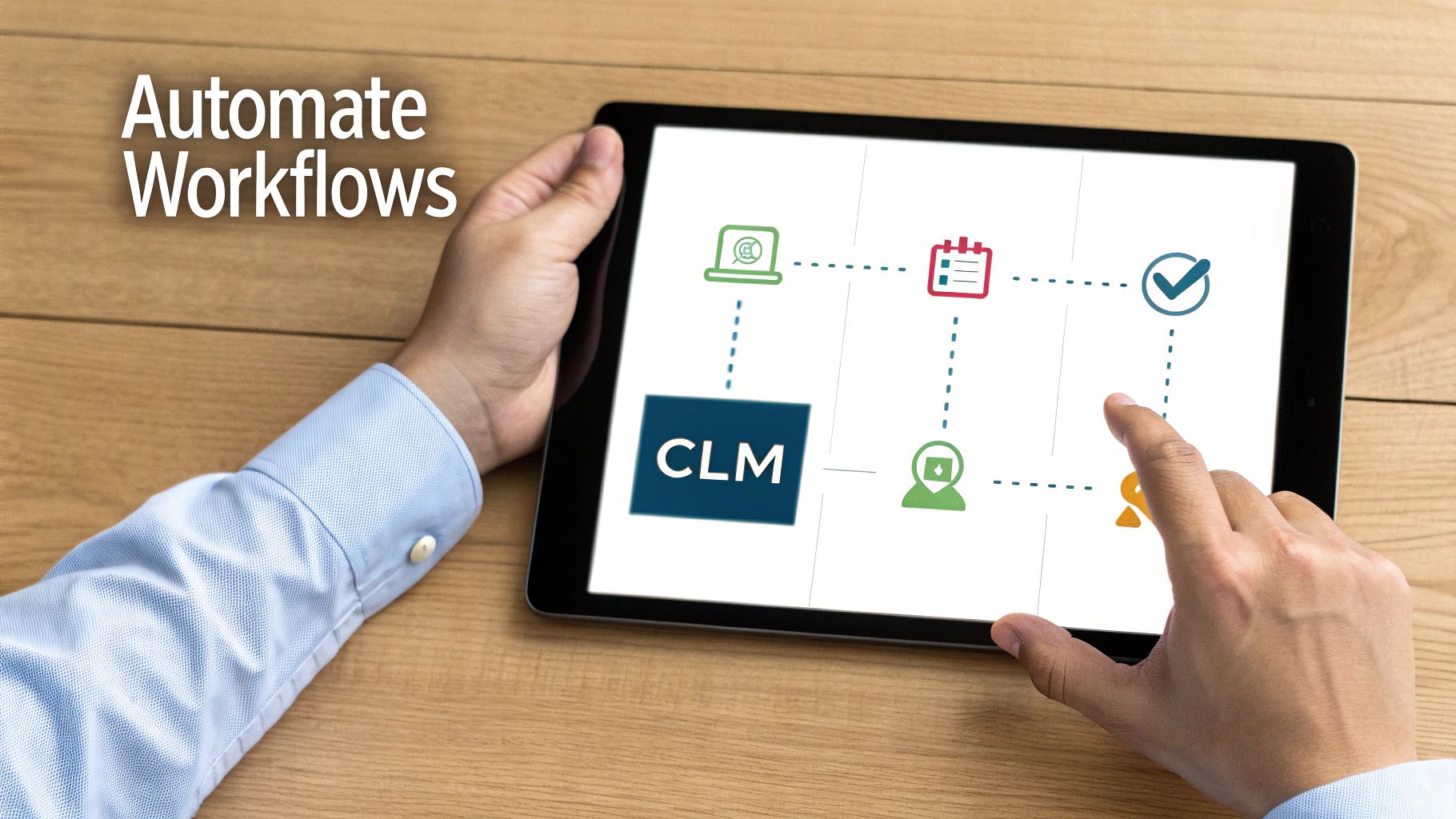
Another essential contract management best practice is implementing automated workflows to guide agreements through each lifecycle stage. These workflows eliminate manual handoffs and ensure consistency from initiation and drafting to review, approval, signature, and post-execution management. Automation provides real-time visibility into every contract's status, preventing deals from stalling in someone's inbox.
By mapping out the contract journey and assigning tasks automatically, these systems reduce human error and accelerate the entire process. Notifications and automated escalations keep stakeholders accountable and proactively address bottlenecks before they cause significant delays. This structured approach transforms contracting from a chaotic, reactive process into a predictable and efficient business function.
Why It's a Top Practice
Without automation, contract processes are plagued by delays, a lack of transparency, and compliance risks. Manual routing leads to missed steps, unapproved changes, and a complete inability to track progress effectively. Automated CLM workflows create a clear, enforceable system that guarantees every contract follows the prescribed approval chain, significantly reducing cycle times and operational risk. For example, Ironclad's workflow automation is renowned for helping SaaS companies accelerate their time-to-signature, while startups often use Airtable-based systems to track contract status visually.
How to Implement This Practice
- Map Existing Processes: Before automating, thoroughly map your current contract lifecycle to identify bottlenecks, redundant steps, and key stakeholders. This blueprint is critical for designing an effective workflow.
- Start with High-Volume Agreements: Begin your automation journey with high-volume, low-complexity contracts like Non-Disclosure Agreements (NDAs) or standard sales orders. This allows you to demonstrate quick ROI and refine your process.
- Integrate Key Tools: Connect your CLM workflow to essential business systems. An integration with an e-signature platform like DocuSign automates the final execution step, while a CRM connection can trigger contract creation automatically.
- Set Up Automated Alerts: Build rules for notifications and escalations. Configure automatic renewal reminders 90-120 days before expiration and set alerts that flag any contract sitting in a single stage for too long.
5. Change Tracking and Redline Management with Detailed Attribution
A disciplined approach to managing contract edits and negotiations is crucial. Rather than passing uncontrolled Word documents back and forth via email, this best practice involves using systems that meticulously track every modification. This ensures all redlines and comments are clearly highlighted, attributed to specific individuals with timestamps, and organized into a clean revision history.
This level of detail brings much-needed transparency and accountability to the negotiation process. It eliminates the risk of accidentally accepting unfavorable or hidden changes slipped into a document. By creating a definitive record of who changed what and when, organizations can maintain a strong negotiating position and prevent disputes over the final agreed-upon terms.
Why It's a Top Practice
Without systematic change tracking, the negotiation phase becomes chaotic and risky. Edits can be lost, multiple "final" versions can circulate simultaneously, and it's nearly impossible to reconstruct the negotiation history if a dispute arises. This practice transforms a high-risk, manual process into a controlled, auditable workflow. For example, platforms like Ironclad and DocuSign offer collaborative editing with detailed attribution, while specialized tools like DealRoom create dedicated negotiation workspaces with granular change tracking.
How to Implement This Practice
- Centralize All Edits: Establish a firm policy that all contract negotiations must occur within your contract lifecycle management (CLM) platform, not through email attachments.
- Leverage AI for Review: Use tools that automatically surface all changes between versions. Legal Chain’s AI-powered review highlights every modification, ensuring no edit goes unnoticed before acceptance.
- Require Justification for Key Changes: Create a protocol where any proposed changes to critical clauses, like payment terms, liability, or intellectual property, must be accompanied by an explanatory comment.
- Maintain a Version History Log: Ensure your system archives each round of redlines. This log should be stored with the final signed agreement for future reference and dispute resolution.
6. Pre-Signature Verification and Blockchain-Backed Document Integrity
Effective contract management best practices must address a critical vulnerability: ensuring the document signed is the exact version that was approved. Pre-signature verification combined with blockchain-backed integrity creates an unbreakable, tamper-evident seal on the final contract. This practice guarantees that the document is complete, authentic, and cryptographically locked before it ever reaches the signatories.
This dual approach first verifies the document’s readiness for execution, checking for all necessary signatures, attachments, and compliance with approved templates. Then, it anchors the final version’s unique cryptographic hash to a blockchain. This creates an immutable, time-stamped record, providing undeniable proof of the document's state at the moment of approval. Any subsequent alteration, however small, would change the hash, instantly revealing the tampering.
Why It's a Top Practice
Without this cryptographic assurance, parties are vulnerable to disputes over "what was actually agreed upon." A counterparty could maliciously or accidentally sign a slightly altered version, leading to costly litigation. By creating an immutable record before signing, you eliminate this risk entirely. For high-value agreements, such as those in finance or supply chain management, this level of integrity is not just a best practice; it is an essential safeguard.
How to Implement This Practice
- Create Pre-Signature Checklists: Develop a mandatory checklist for each contract type, outlining required elements like dates, schedules, and specific clauses that must be present before signing.
- Anchor Final Versions: Before sending a document for signature, use a service like Legal Chain’s integrity layer to generate a cryptographic hash and anchor it to a blockchain. This creates your immutable proof of the approved version.
- Establish a Verification Protocol: Document the process for what happens if verification fails. The protocol should dictate that the contract is not executed and is returned for correction, preventing flawed agreements from proceeding.
- Retain Verification Metadata: Store the cryptographic hash, blockchain transaction ID, and verification reports alongside the final executed contract. This data serves as your definitive evidence in any future audit or dispute.
7. Post-Signature Obligation Tracking and Compliance Monitoring
Signing a contract is not the end of the process; it’s the beginning of a new set of responsibilities. Post-signature obligation tracking is a systematic approach to identifying, monitoring, and fulfilling all contractual duties after an agreement is executed. This practice transforms static documents into active, manageable commitments, ensuring that deadlines, deliverables, and compliance requirements are never missed.
This proactive approach prevents contracts from becoming dormant liabilities. Instead of being filed away and forgotten, each agreement's key dates, payment terms, reporting requirements, and termination rights are actively managed. This diligence is crucial for mitigating risk, preventing financial leakage from missed renewals or penalties, and maintaining strong counterparty relationships built on reliability and trust.
Why It's a Top Practice
Without active tracking, businesses risk accidental non-compliance, which can lead to financial penalties, damaged reputations, and even legal disputes. Forgetting a renewal date for a critical software license or failing to meet a service-level agreement (SLA) can have severe operational consequences. This practice ensures that every commitment is visible, assigned, and acted upon, making it one of the most critical contract management best practices for maintaining organizational integrity and financial health. For example, Thomson Reuters' contract management module is often used to monitor complex SLA and service-level obligations in enterprise agreements.
How to Implement This Practice
- Extract Obligations Immediately: Capture all key dates and obligations right after signing, while the context is still fresh for all stakeholders.
- Use Standardized Templates: Create a checklist or template to standardize the extraction of key terms like payment schedules, renewal deadlines, insurance requirements, and reporting duties.
- Assign Clear Ownership: Assign a specific person or department responsible for each contractual obligation. For instance, Finance owns payment schedules, while the relevant department head owns service deliverables.
- Set Escalating Alerts: Implement automated reminders for critical dates. A common best practice is to set alerts for 90, 60, 30, and 14 days before a renewal or termination deadline to allow ample time for review and action.
- Create a Compliance Dashboard: Develop a centralized dashboard that provides executive visibility into upcoming commitments, potential risks, and contract expiration dates, enabling strategic decision-making.
8. Collaborative Drafting with Role-Based Workflows and Legal Review Gates
Effective contract drafting is rarely a solo effort; it's a collaborative process that requires input from commercial, legal, and compliance teams. This best practice involves creating a structured, role-based workflow where drafts move through predefined "gates" for review and approval. It replaces chaotic email chains with an organized system, ensuring the right people provide input at the right time.
This approach balances the need for speed from commercial teams with the legal and compliance requirements for risk mitigation. By defining clear roles and approval stages, you prevent bottlenecks and reduce endless back-and-forth revision cycles. For example, a sales team can initiate a draft from a pre-approved template, which then automatically routes to legal for review before it can be sent to the counterparty.
Why It's a Top Practice
Without structured workflows, the drafting process becomes a major source of friction and delay. Commercial teams might use outdated templates, or legal might be brought in too late, forcing major redlines that kill deal momentum. Implementing role-based workflows and review gates ensures that every contract is vetted for compliance, risk, and commercial viability before it ever leaves the building. Enterprise CLM systems like ServiceNow and Ironclad have built entire platforms around this concept, guiding contracts through multi-stakeholder approval hierarchies.
How to Implement This Practice
- Define Roles and Authorities: Clearly map out who can initiate a contract, who needs to review it (e.g., Legal, Finance, InfoSec), and who has final approval authority. Document this in a clear policy.
- Establish Review Gates: Create mandatory checkpoints in the contract lifecycle. For instance, a contract cannot proceed to negotiation until both the commercial lead and legal counsel have approved the initial draft.
- Set Service-Level Agreements (SLAs): Assign timeframes for each review stage (e.g., legal review must be completed within 48 hours). This creates accountability and keeps the process moving.
- Use AI-Assisted Drafting: Leverage tools like Legal Chain’s AI drafter to generate the initial contract from a pre-approved template. This ensures consistency and frees up legal resources to focus on high-level review rather than boilerplate language.
9. Contract Data Extraction and Analytics for Business Intelligence
Beyond simple storage and tracking, one of the most transformative contract management best practices is treating your agreements as a rich source of business intelligence. This involves systematically extracting structured data points from your contracts, such as payment terms, renewal dates, liability caps, and termination triggers, and aggregating this information for strategic analysis. It turns static legal documents into dynamic, queryable assets that reveal risks and opportunities.
This practice moves contract management from a reactive administrative function to a proactive, strategic one. By analyzing aggregated data, organizations can identify financial exposure across their entire portfolio, spot trends in vendor terms, and pinpoint ideal moments for renegotiation. Instead of being locked away in PDFs, critical business data becomes accessible, enabling leaders to make more informed decisions.
Why It's a Top Practice
Without systematic data extraction, your contract portfolio is a black box of untapped intelligence. You might be unaware of multiple contracts with conflicting liability terms or miss opportunities to consolidate vendors for better pricing. Extracting and analyzing this data provides a panoramic view of your commitments and obligations. For instance, Deloitte leverages contract analytics to help Fortune 500 companies optimize their vendor portfolios, uncovering millions in savings by identifying redundant services and non-compliant terms.
How to Implement This Practice
- Prioritize High-Impact Data Fields: Begin by focusing on extracting data with the most immediate business impact. Key fields include renewal and termination dates, payment terms, liability limitations, and any volume or service level commitments.
- Leverage AI for Automated Extraction: Manually extracting data is slow and prone to error. Use tools like Legal Chain’s AI to automatically identify and pull structured data from contracts during the review phase, ensuring accuracy and consistency.
- Create a Centralized Data Dictionary: Establish clear, standardized definitions for each data field (e.g., what constitutes an "auto-renewal clause"). This ensures everyone in the organization interprets the data uniformly for reliable reporting.
- Build Role-Specific Dashboards: Visualize the extracted data in dashboards tailored to different departments. Finance can track payment obligations and revenue forecasts, while Legal can monitor risk exposure and compliance metrics.
- Conduct Quarterly Portfolio Reviews: Use the data to conduct regular strategic reviews. Analyze trends to identify contracts that are ripe for renegotiation, benchmark your terms against industry standards, and forecast future financial commitments.
10. Vendor and Counterparty Risk Management with Contract Governance
Effective contract management extends beyond the document itself to encompass the risks associated with the parties involved. Proactive vendor and counterparty risk management involves a structured approach to assessing, monitoring, and mitigating potential threats from third parties. This governance framework ensures you don't treat all vendors equally but apply scrutiny proportionate to their criticality and risk level.
Instead of a one-size-fits-all approach, this practice uses contracts as a primary tool for risk control. It involves embedding specific requirements like insurance minimums, audit rights, data security protocols, and termination triggers directly into agreements based on the vendor's importance. This transforms contracts from static legal documents into dynamic instruments for ongoing risk oversight and operational resilience.
Why It's a Top Practice
Failing to manage counterparty risk can lead to catastrophic disruptions, from supply chain failures and data breaches to regulatory fines and reputational damage. A high-risk vendor's failure can halt your operations entirely. By establishing a tiered governance system, organizations can focus their resources on the most critical relationships, ensuring robust protections are in place where they matter most. For example, financial services firms mandate audited financial statements and robust E&O insurance from all key tech vendors to protect against system failures and data loss.
How to Implement This Practice
- Define Vendor Risk Tiers: Categorize vendors based on their impact on your business: Critical (immediate operational failure), High (significant disruption), Medium (moderate impact), and Low (minimal impact).
- Create Tier-Specific Contract Requirements: Tailor your contract templates for each risk tier. Critical vendors should have contracts with strict audit rights, financial stability covenants, and higher insurance minimums.
- Automate Compliance Checks: Use technology to monitor contractual obligations. Legal Chain's risk analysis can automatically scan your contract portfolio to flag agreements that are missing required insurance clauses, audit provisions, or data security addendums.
- Establish Regular Reviews: Implement a schedule for periodic vendor risk reviews, such as quarterly for critical vendors. These reviews should re-evaluate performance, financial stability, and the continued validity of insurance and other certifications against the contract terms.
- Document Governance Decisions: Maintain a clear, auditable record of why each vendor was placed in a specific tier and the rationale behind the associated governance actions. This documentation is crucial for compliance and regulatory audits.
Contract Management Best Practices: 10-Item Comparison
| Item | Implementation complexity 🔄 | Resource requirements ⚡ | Expected outcomes 📊 | Ideal use cases | Key advantages ⭐ |
|---|---|---|---|---|---|
| Centralized Contract Repository with Version Control | 🔄 Medium — setup & migration, governance | ⚡ Moderate — storage, access controls, training | 📊 High — single source of truth, audit trails; ⭐ High compliance | Enterprises, legal teams, audit-sensitive orgs | Single source of truth; rollback; strong auditability |
| Structured Clause Intelligence and Template Standardization | 🔄 High — build & maintain clause library | ⚡ Moderate — legal input, template tooling, updates | 📊 Very high — faster drafting, consistency; ⭐ High quality | High-volume drafting, startups, repeat agreements | Dramatically faster drafts; consistency; fewer errors |
| Risk-Based Contract Analysis and Scoring | 🔄 Medium-High — model design & calibration | ⚡ Moderate — AI models, SME tuning, integrations | 📊 High — prioritized review, reduced exposure; ⭐ High for risk mitigation | M&A, finance, large portfolios, in-house counsel | Focuses resources on high-risk deals; data-driven alerts |
| Automated Contract Lifecycle Management (CLM) Workflows | 🔄 Medium-High — process mapping & integrations | ⚡ High — platform licenses, integrations, admins | 📊 High — faster time-to-signature, fewer bottlenecks; ⭐ High efficiency | Organizations with many approvals (NDAs, POs, SLAs) | Reduces cycle time; enforces checklists; visibility |
| Change Tracking and Redline Management with Detailed Attribution | 🔄 Medium — tool rollout and adoption | ⚡ Low-Moderate — collaboration tools, training | 📊 High — negotiation transparency; ⭐ High traceability | Complex negotiations, multi-party edits, dispute-prone deals | Clear attribution; dispute support; faster reconciliations |
| Pre-Signature Verification and Blockchain-Backed Document Integrity | 🔄 High — crypto integration & verification flows | ⚡ High — blockchain anchoring, key management | 📊 High — tamper-evident signatures, integrity proof; ⭐ High trust | High-value contracts, regulated industries, audits | Cryptographic proof of integrity; reduces post-signature disputes |
| Post-Signature Obligation Tracking and Compliance Monitoring | 🔄 Medium — obligation extraction & workflows | ⚡ Moderate — calendar, ops/finance integrations | 📊 High — fewer missed obligations, reduced leakage; ⭐ High compliance | Subscription services, SLAs, regulatory obligations | Prevents missed renewals/payments; audit trail for compliance |
| Collaborative Drafting with Role-Based Workflows and Legal Review Gates | 🔄 Medium — role setup, SLAs, gates | ⚡ Moderate — workflow engine, stakeholder training | 📊 Medium-High — balanced speed & quality; ⭐ High governance | Cross-functional approvals, commercial contracts | Controlled collaboration; accountability; fewer late surprises |
| Contract Data Extraction and Analytics for Business Intelligence | 🔄 High — data model, extraction rules, cleanup | ⚡ High — AI extraction, analysts, dashboards | 📊 High — BI insights, renegotiation opportunities; ⭐ High strategic value | Procurement, finance, enterprise portfolio analysis | Data-driven negotiation; trend detection; forecasting |
| Vendor and Counterparty Risk Management with Contract Governance | 🔄 Medium-High — tiered framework & policies | ⚡ Moderate-High — monitoring, audits, insurance checks | 📊 High — reduced operational/financial risk; ⭐ High resilience | Critical vendors, regulated sectors, enterprise risk programs | Tiered controls; insurance/audit enforcement; proactive mitigation |
Building a Resilient, Future-Proof Contracting Process
The journey from chaotic, manual contract handling to a streamlined, strategic function is not a single leap but a series of deliberate steps. Throughout this guide, we've explored ten foundational contract management best practices, moving from reactive problem-solving to proactive, data-driven governance. We've seen how a centralized repository eliminates silos, how structured clause intelligence brings consistency, and how automated workflows reclaim countless hours lost to administrative tasks. The common thread is a fundamental shift in perspective: treating contracts not as static legal documents, but as dynamic, strategic assets teeming with valuable data and critical obligations.
Implementing these practices transforms contracts from potential liabilities into powerful tools for growth, risk mitigation, and operational efficiency. By embracing structured change tracking, pre-signature integrity checks, and post-signature monitoring, you build a fortress of compliance and accountability around your business relationships. You move beyond simply getting a deal signed; you ensure the value of that deal is realized and protected throughout its entire lifecycle.
The Cumulative Impact of Best Practices
Adopting even one of these best practices, such as standardizing your templates or centralizing your agreements, will yield immediate benefits. However, their true power is unlocked when they are integrated into a cohesive strategy.
- Synergistic Risk Mitigation: A centralized repository (Practice #1) combined with risk-based analysis (Practice #3) and vendor governance (Practice #10) creates a comprehensive view of your entire risk landscape. You can identify which counterparties and which specific clauses pose the greatest threat to your organization.
- Accelerated Business Velocity: Automated workflows (Practice #4) paired with collaborative drafting tools (Practice #8) and clear redline management (Practice #5) dramatically reduce the time from initial request to final signature. This allows your sales, procurement, and partnership teams to close deals faster and capitalize on opportunities without being bogged down by legal bottlenecks.
- Enhanced Business Intelligence: When you extract contract data (Practice #9) from a well-organized and standardized set of agreements (Practice #2), you gain unparalleled insights. You can forecast revenue more accurately, identify cost-saving opportunities, and make strategic decisions based on empirical data rather than guesswork.
The ultimate goal of modern contract management is not merely to manage documents, but to orchestrate relationships, mitigate risk, and unlock the strategic value embedded within every single agreement.
Your Actionable Path Forward
The prospect of overhauling your entire contracting process can feel daunting, but progress begins with a single, focused action. Don't aim for a complete transformation overnight. Instead, identify your organization's most significant point of friction and start there.
- Assess Your Current State: Where are the biggest delays? Is it in the initial drafting, the review cycles, or finding executed agreements? A simple audit of your process will reveal the most critical area for improvement.
- Choose a High-Impact Starting Point: For many, the first and most impactful step is creating a centralized contract repository. Simply knowing what contracts you have and where they are is a revolutionary improvement. For others, standardizing templates and clauses will deliver the quickest win by reducing drafting time and negotiation friction.
- Leverage Technology as an Enabler: Attempting to implement these contract management best practices with spreadsheets and shared drives is an uphill battle. Modern tools like Legal Chain are specifically designed to be the engine for this transformation, providing the AI-powered intelligence for review, the automation for workflows, and the tamper-evident trust layer for document integrity.
By methodically building upon these principles, you construct a resilient, scalable, and future-proof contracting function. You empower your legal team to operate as strategic advisors rather than administrative gatekeepers and provide the entire organization with the clarity and security it needs to thrive. The investment you make in optimizing your contract management process today will pay dividends in efficiency, compliance, and competitive advantage for years to come.
Ready to transform your contract management from a manual burden into a strategic advantage? Discover how Legal Chain integrates AI-powered drafting, intelligent clause analysis, and a tamper-evident trust layer to help you implement these best practices seamlessly. Visit Legal Chain to see how our platform empowers organizations to build a faster, smarter, and more secure contracting process.
