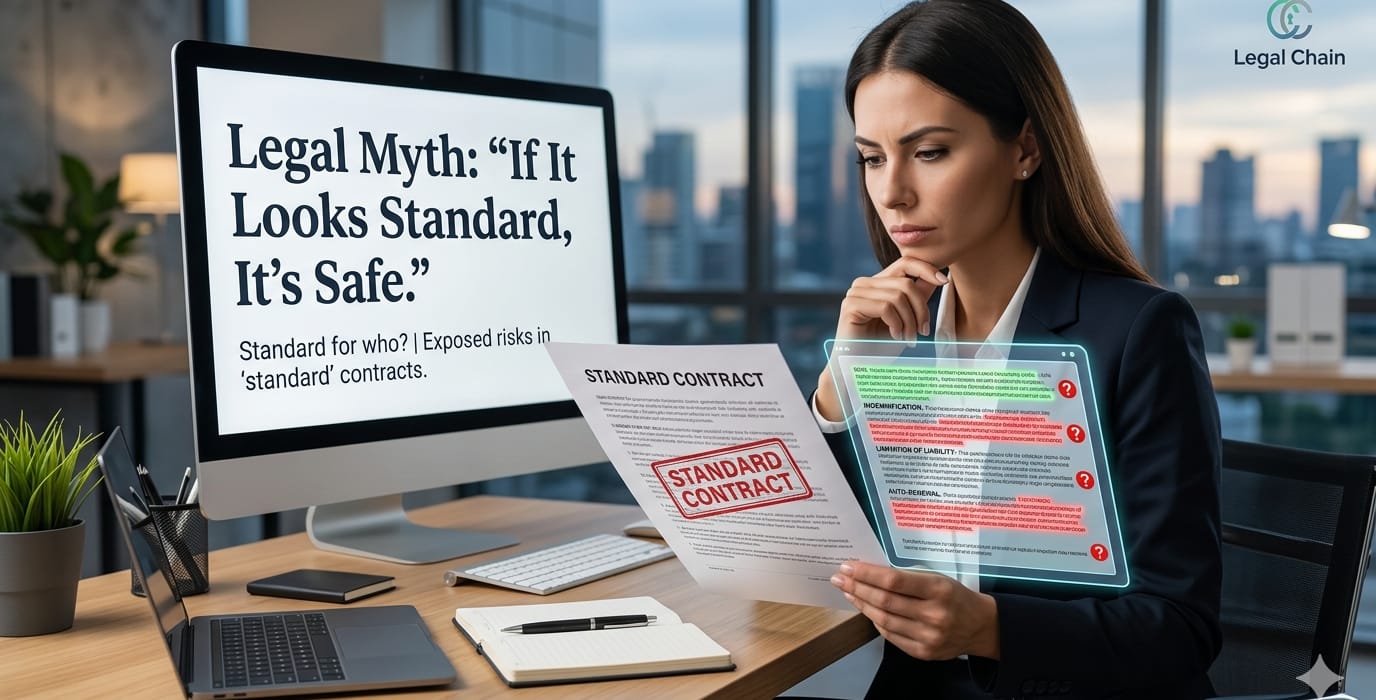
Legal Myth: “If It Looks Standard, It’s Safe.”
Standard for who?
This is one of the most dangerous assumptions in modern business. Contracts labeled as “standard,” “template,” or “boilerplate” are often treated as inherently safe. In reality, “standard” rarely means neutral—and almost never means risk-free.
At Legal Chain, we analyze contracts every day. One of the most consistent risks we see comes from agreements that appear familiar but contain terms heavily skewed toward one party.
What Does “Standard” Actually Mean?
In legal contexts, “standard” typically reflects the preferences of the party that drafted the agreement—not an objective industry consensus. That means:
- A vendor’s “standard contract” protects the vendor
- An employer’s “standard agreement” protects the employer
There is no universal governing body that certifies contracts as “safe.” The term is informal and often misleading.
Why “Standard” Contracts Can Be Risky
Even widely used templates can contain provisions that expose you to significant risk. Common examples include:
- Broad indemnification clauses that shift disproportionate liability onto you
- Auto-renewal terms with restrictive cancellation windows
- Limitation of liability clauses that severely cap your ability to recover damages
- Jurisdiction clauses forcing disputes into unfavorable or distant courts
- Ambiguous language that can be interpreted against your interests
According to guidance from the American Bar Association, contract language must always be evaluated in context, including the parties, jurisdiction, and specific transaction details.
The Hidden Cost of Assumptions
Relying on “standard” contracts without review can lead to:
- Unexpected financial liability
- Loss of intellectual property rights
- Operational constraints
- Costly disputes and litigation
These risks are rarely obvious at a glance. They are embedded in dense legal language that requires careful analysis.
How to Evaluate a “Standard” Contract
Before signing any agreement labeled “standard,” ask:
- Who drafted this document?
- Which party benefits most from the terms?
- What happens if something goes wrong?
- Are key obligations clearly defined?
- Is there flexibility to negotiate?
If you cannot confidently answer these questions, the contract requires deeper review.
How Legal Chain Helps
Legal Chain simplifies contract analysis by identifying key risks, summarizing complex clauses, and helping you understand what you are actually agreeing to—before you sign.
Our platform is designed to make legal clarity accessible, whether you are a founder, operator, or individual reviewing an agreement.
Try the beta: https://legalcha.in
Related Articles
- What to Look for in a Contract Before Signing
- 10 Common Contract Red Flags
- Understanding Legal Terms in Plain English
Frequently Asked Questions
Are standard contracts legally binding?
Yes. A contract labeled “standard” is still fully enforceable once signed, regardless of whether you reviewed all terms.
Can standard contracts be negotiated?
Often, yes. Many “standard” agreements are starting points and can be modified depending on leverage and context.
Do I need a lawyer to review every contract?
Not always, but professional review is recommended for high-risk or high-value agreements. Tools like Legal Chain can help you identify when deeper review is necessary.
