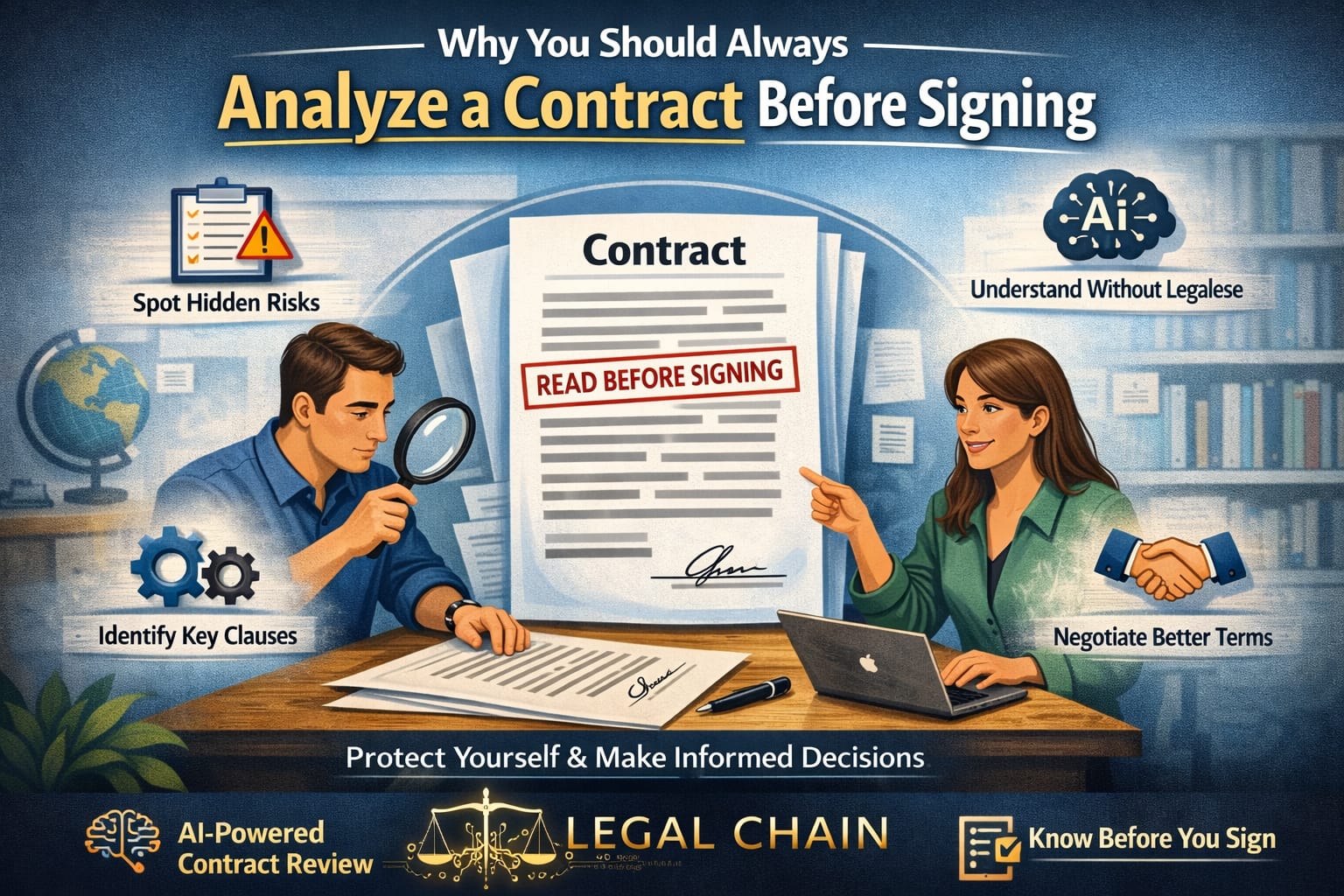
Why Analyzing a Contract Before You Sign It Is One of the Most Important Decisions You Can Make
Every day people sign contracts — employment agreements, leases, NDAs, service agreements, partnership deals, and countless other legal documents.
Yet many people sign these documents without fully understanding what they actually say.
Contracts are often written in dense legal language filled with complex clauses, cross references, and terminology that can be difficult to interpret without legal training.
Understanding what you are agreeing to before signing a contract is critical. A contract creates legally binding obligations, and once it is signed, reversing or changing its terms can be difficult and costly.
This is why the ability to analyze and summarize a contract before signing it is so important.
Why Contract Analysis Matters
A contract is more than just paperwork — it defines the rights, responsibilities, and risks of the parties involved.
Analyzing a contract allows you to:
- Understand the obligations you are agreeing to
- Identify potential risks and liabilities
- Clarify confusing legal terminology
- Recognize clauses that may need negotiation
- Ensure the agreement reflects what was actually discussed
Without proper analysis, individuals and businesses can unknowingly agree to terms that expose them to unnecessary risk.
According to the American Bar Association, poorly understood contracts are one of the most common sources of business disputes.
Contracts Are Often Written in Legalese
Legal documents traditionally use a writing style often referred to as legalese. This style evolved over centuries of legal practice and frequently includes:
- Complex sentence structures
- Archaic terminology
- Cross-referenced clauses
- Highly specific definitions
While legal precision is important, this complexity can make contracts difficult for non-lawyers to understand.
Even experienced professionals sometimes struggle to interpret dense contract language.
The ability to translate legal language into clear summaries allows individuals and organizations to understand agreements without needing to decipher every legal phrase.
Contract Analysis Helps Identify Risk
Many contracts contain clauses that can significantly impact your legal or financial exposure.
Examples include:
- Indemnification clauses
- Limitation of liability provisions
- Termination conditions
- Automatic renewal terms
- Jurisdiction or governing law clauses
These provisions may not always be obvious when quickly reviewing a document.
Contract analysis tools and legal review processes help highlight these clauses so they can be properly evaluated before signing.
The Cornell Law School Legal Information Institute explains that contract terms determine enforceability and obligations once the agreement is executed.
Summarization Makes Contracts Easier to Understand
Summarizing a contract helps transform long, technical documents into clear insights.
A well-structured summary typically highlights:
- The purpose of the agreement
- The obligations of each party
- Key deadlines and milestones
- Payment terms
- Risk-related clauses
This allows decision-makers to quickly understand the structure of a contract before reviewing it in full detail.
Clause Identification Enables Better Negotiation
Contracts are often negotiable.
However, many people assume that agreements must be accepted exactly as written.
In reality, businesses and individuals frequently negotiate terms such as:
- Payment structures
- Termination rights
- Confidentiality provisions
- Liability limitations
By identifying key clauses in advance, parties can request revisions that better align with their interests.
Why Contract Review Should Happen Before Signing
Once a contract is signed, it becomes legally binding.
While amendments may be possible, renegotiating terms after execution can be complicated and sometimes impossible without the agreement of all parties.
Conducting contract analysis beforehand provides the opportunity to:
- Ask questions
- Clarify unclear provisions
- Seek legal advice if necessary
- Negotiate better terms
How Technology Is Making Contract Analysis More Accessible
Advances in artificial intelligence and legal technology are making contract analysis more accessible than ever.
Modern legal tools can:
- Analyze large contracts quickly
- Summarize complex agreements
- Highlight key clauses and obligations
- Identify potential legal risks
This allows individuals, startups, nonprofits, and businesses to better understand documents before committing to them.
Platforms such as Legal Chain are designed to simplify this process by helping users review contracts, understand legal language, and gain clarity before signing agreements.
Key Takeaway
Signing a contract without understanding it can lead to unexpected obligations, financial exposure, or legal disputes.
Taking the time to analyze and summarize an agreement before signing helps ensure that you fully understand what you are committing to.
Whether reviewing a lease, employment contract, NDA, or service agreement, informed decision-making starts with clarity.
Understanding a contract before signing it is not just good practice — it is essential protection.
Try Contract Analysis with Legal Chain
If you want to better understand contracts without spending hours decoding legal language, you can explore the Legal Chain platform.
Legal Chain helps individuals and organizations review and analyze legal documents with greater clarity.
Try the free beta:
