How Accurate Is AI Contract Review?
For clause identification in standard contracts, AI is more accurate than manual attorney review. For jurisdiction-specific compliance, purpose-built legal AI outperforms general tools. For judgment tasks, accuracy is the wrong question entirely.
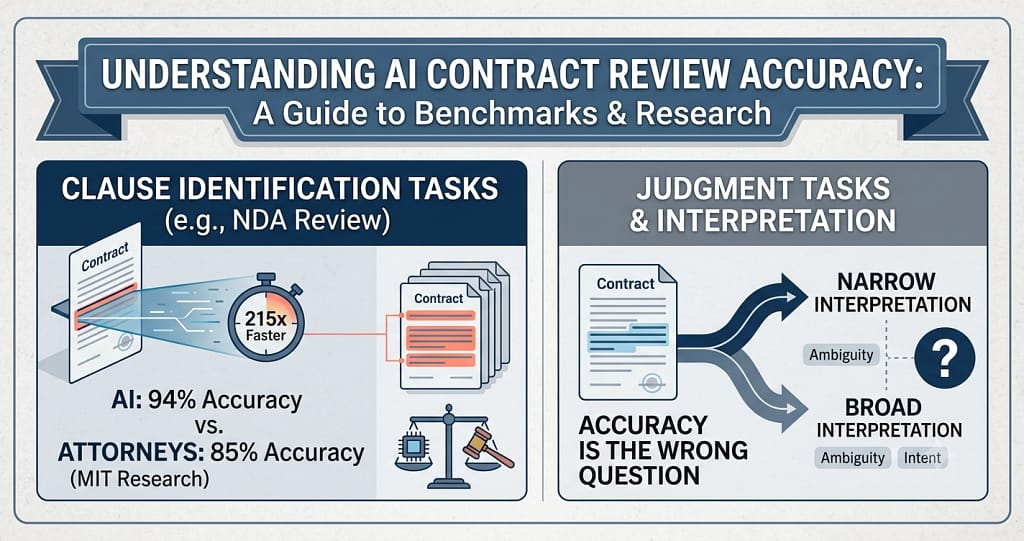
AI contract review accuracy varies by task. For clause identification in standard contracts, MIT research found 94% AI accuracy versus 85% for attorneys. For jurisdiction-specific compliance checking, purpose-built legal AI trained on verified current statutes consistently outperforms general AI. For judgment tasks — interpreting ambiguous language, predicting outcomes, advising strategy — accuracy is not a meaningful measure for current AI tools. The right question is not whether AI is accurate, but accurate at which tasks compared to which alternative. Try Legal Chain free at legalcha.in/beta.

AI contract review accuracy is not a single number. It is a function of the task type, the contract type, the AI tool’s architecture, and the alternative being compared against. The MIT benchmark is the most cited data point — but understanding what it measures and what it does not is as important as the number itself. Photo: Unsplash / Austin Distel
Why “How Accurate Is AI Contract Review?” Has No Single Answer
The question of AI contract review accuracy is almost always asked without specifying what task the accuracy is being measured against. Accuracy at what? Identifying that an indemnification clause is present? Determining whether it is unlimited? Assessing whether it creates more exposure than the limitation of liability clause protects against? Predicting whether a court in a specific jurisdiction would enforce it as written?
These are four different tasks. AI performs each with a different level of reliability. The same AI tool that identifies a clause with 94% accuracy may produce an unreliable assessment of how a court would rule on its enforceability. Conflating these tasks into a single accuracy question leads to either overconfidence or unnecessary skepticism — both of which result in worse outcomes than understanding the task-by-task picture.
AI Contract Review Accuracy by Task Type
| Task | AI accuracy (purpose-built) | Manual attorney accuracy | Notes |
|---|---|---|---|
| NDA clause identification | 94% (MIT) | 85% (MIT) | AI outperforms attorneys on both speed and accuracy for this task |
| Standard provision detection | High — systematic | Variable — depends on fatigue and focus | AI does not tire; human accuracy degrades over long documents |
| Missing provision detection | High — systematic | Low — focus on present provisions | AI checks for what should be there; humans focus on what is |
| Jurisdiction-specific compliance | High (purpose-built) / Low (general AI) | High (specialist) / Low (generalist) | Both AI and attorneys are only as accurate as their jurisdiction knowledge |
| Benchmark comparison vs market | High — data-driven | Variable — depends on deal volume | AI benchmarks against actual data; attorneys rely on experience |
| Ambiguous language interpretation | Moderate — flags ambiguity, cannot resolve it | High (with local precedent knowledge) | Attorney with jurisdiction knowledge outperforms AI on resolution |
| Negotiation strategy advice | Not applicable | High (experienced specialist) | Requires business judgment AI does not provide |
| Court outcome prediction | Not applicable | Moderate (experienced specialist) | Requires legal judgment and local precedent knowledge |
The MIT Study: What the 94% Accuracy Finding Actually Means
26 seconds per NDA
92 minutes per NDA
The MIT finding is the most frequently cited data point in AI legal review — and the most frequently misunderstood. The study measured clause identification accuracy: given a set of NDAs, could AI correctly identify whether standard clauses were present, absent, or problematic? That is a specific and valuable task. It is not the same as:
Determining whether the clause is enforceable in a specific US state. Identifying whether the clause interacts with another provision in a way that creates unexpected liability. Detecting that a clause which should be present is absent. Evaluating whether the clause’s terms are below market standard for the document type. Advising on whether to negotiate the clause and how.
Accordingly, the 94% figure is accurate for what it measures — and limited in scope. Purpose-built legal AI that applies jurisdiction-specific law and compares provisions against market benchmarks performs additional tasks that the MIT study did not evaluate — tasks that are equally important for business contract review.

The MIT study’s 94% accuracy finding applies to NDA clause identification — a specific, valuable, and well-defined task. Understanding what it does and does not measure is essential for evaluating AI contract review tools accurately. Purpose-built legal AI performs additional tasks beyond clause identification that the study’s scope did not include. Photo: Unsplash / LinkedIn Sales Solutions
What Affects AI Contract Review Accuracy
General AI tools generate contract analysis through pattern matching on training data. Purpose-built legal AI using chain-of-thought architecture reasons through each provision — identifying jurisdiction, retrieving verified statute, applying it to context, and verifying output. The architectural difference is the primary determinant of accuracy for jurisdiction-specific compliance tasks. Pattern matching produces fluent but potentially outdated or jurisdiction-inappropriate analysis. Chain-of-thought verification produces grounded, verifiable outputs.
AI trained on a general corpus of internet text — including legal documents — produces outputs shaped by the distribution of that corpus. If the corpus contains more contracts from one jurisdiction, the AI will produce outputs weighted toward that jurisdiction’s norms. Purpose-built legal AI trained on a verified, jurisdiction-specific legal database produces outputs grounded in the specific applicable statutes. The training data source is the second most important determinant of compliance accuracy.
General AI models have training data cutoffs. Statutes change. Illinois raised the non-compete threshold under the Freedom to Work Act. Washington updated its annual non-compete salary ceiling. New York expanded freelancer payment protection thresholds. An AI trained before these changes produces incorrect compliance analysis with high confidence and no indication of error. Legal AI with an updated legal database reflects current statutes — the currency of the legal knowledge is as important as its initial accuracy.
AI accuracy is highest for contract types well-represented in training data — NDAs, standard vendor agreements, employment offer letters, SAFEs. Accuracy decreases for novel financial instruments, cross-jurisdictional arrangements without established precedent, or highly customized agreements with non-standard provision structures. The MIT 94% benchmark was measured on NDAs — a well-standardized contract type. Accuracy on more complex or novel documents is lower and should be treated as a first-pass that warrants attorney review of flagged provisions.
“The right question is not ‘how accurate is AI contract review?’ The right question is ‘how accurate is this AI tool at this specific task for this specific contract type, compared to the alternative?’ Clause identification in a standard NDA: AI wins. Jurisdiction compliance on a standard vendor agreement: purpose-built AI wins over general AI. Negotiation strategy for a complex acquisition: attorney wins. The task determines the answer.”
Frequently Asked Questions
Purpose-built AI contract review. Verified against current law. Free.
Chain-of-thought architecture. Verified statutes for all 50 US states. 94%+ clause identification accuracy. Jurisdiction-specific compliance checking. Risk score benchmarked against market data. No credit card required.
Try Legal Chain TodayDisclaimer
Accuracy benchmarks cited in this article are drawn from published research and may not reflect all contract types, jurisdictions, or use cases. Legal Chain is a technology platform and is not a law firm. Use of Legal Chain does not create an attorney-client relationship. For contracts with significant legal or financial implications, consult a licensed attorney. Legal Chain currently supports US jurisdictions only.
Discover more from Legal Chain
Subscribe to get the latest posts sent to your email.
Try Legal Chain Free Today
Draft, analyze, and protect your contracts with AI. No credit card required.
View pricing Legal Chain is a technology platform. Not legal advice.
