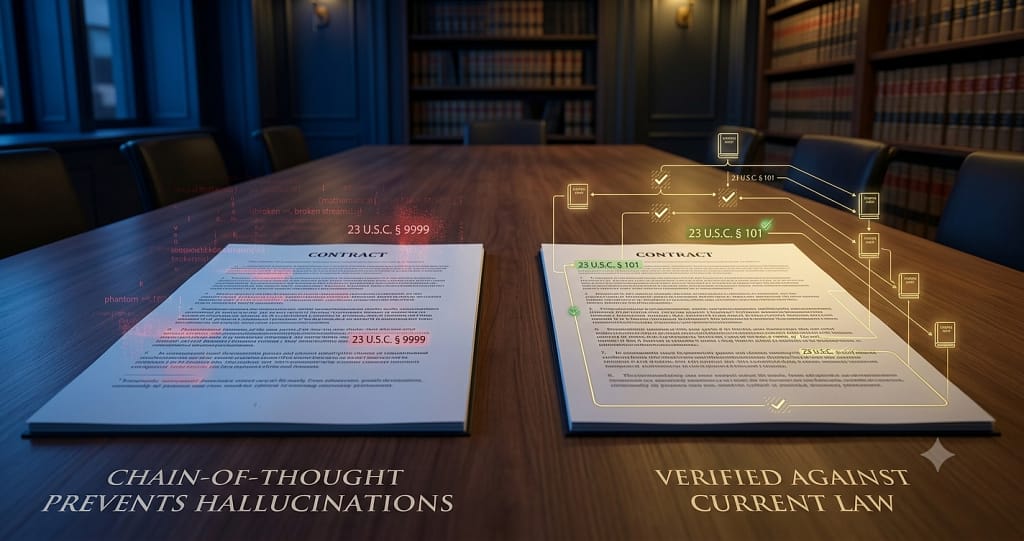
How Legal Chain Uses Structured Chain-of-Thought AI to Prevent Contract Hallucinations
A hallucinated statute in a contract is not a minor error. It is a provision both parties may sign and rely on — citing a legal standard that does not exist. Preventing it requires more than a good language model. It requires a structured reasoning architecture.
Legal Chain prevents contract hallucinations through structured chain-of-thought AI: a reasoning architecture that requires the model to identify the applicable jurisdiction, retrieve the verified statute, apply it to the specific contract context, and confirm the output against the source — before generating the provision. If any step in the chain cannot be completed with verified information, the model flags the gap rather than filling it. Try Legal Chain free at legalcha.in/beta.

Chain-of-thought AI architecture requires the model to reason through each step explicitly rather than generating output through pattern matching alone. In legal document generation, this distinction determines whether the output is verifiably grounded or fluently hallucinated. Photo: Unsplash / Google DeepMind
What Contract Hallucinations Actually Look Like
AI hallucinations in legal documents are not obvious errors. They are confident, fluent, structurally correct provisions that cite non-existent statutes, apply incorrect thresholds, or reference regulatory requirements that have either changed or never applied to the situation.
They are dangerous precisely because they look right. A contract reviewer who is not a lawyer in the specific jurisdiction has no way to identify a hallucinated threshold — the provision reads exactly like a real one, because the AI has been trained on the pattern of how real provisions read.
The three examples above show the same provision type — non-compete enforceability and IP assignment — in two versions. The hallucinated versions cite a non-existent statute (California Business Code Section 16742 does not exist), state the wrong threshold ($50,000 instead of $75,000 for Illinois), and add an income qualifier to the California IP assignment carve-out that does not exist in the statute. Each error is embedded in a fluent, professionally formatted provision that would pass a non-specialist review.
What Chain-of-Thought AI Is — and Why It Matters for Legal Documents
Chain-of-thought prompting is an AI architecture technique where the model is structured to reason through a problem in explicit sequential steps — rather than generating an answer directly from pattern matching. Each step in the chain must be completed before the next begins, and the output of each step is verifiable against the inputs. In legal AI, chain-of-thought architecture prevents hallucinations by requiring the model to identify, retrieve, apply, and verify each legal standard before including it in the output — rather than predicting what a legal provision should look like based on training patterns alone.
Standard language models generate text by predicting the most likely next token given the preceding context. For general content, this produces useful output. For legal documents, it produces fluent text that may have no grounding in actual law — because the most likely way a non-compete provision reads in training data is not the same as the current statute in a specific state.
Chain-of-thought architecture changes the generation process. Instead of predicting the provision directly, the model reasons through the chain: what jurisdiction applies, what statute governs this provision type, what the specific threshold or requirement is, and whether the proposed provision accurately reflects it. The chain requires each step to be completed with verifiable information before proceeding to the next.
Legal Chain’s Structured Chain-of-Thought: The Four-Step Reasoning Chain
Before generating any provision, the model identifies the applicable US state and any relevant sub-jurisdictions. Jurisdiction determines which statutes apply — and California, Illinois, Washington, New York, Montana, and every other state have materially different requirements for non-competes, IP assignments, employment terms, and contractor classification. A provision that is correct in Delaware may be void in California. The chain begins with jurisdiction because everything that follows depends on it.
The model retrieves the applicable statute or regulatory standard from a verified legal corpus — not from general training data that may be outdated or conflated across jurisdictions. The retrieval includes the current version of the statute, the specific threshold or requirement, and any recent amendments that affect the provision. For the Illinois Freedom to Work Act, this means retrieving the current annual adjustment to the $75,000 threshold. For California BPC 16600, it means retrieving the current text and confirming no exceptions apply to the document type being generated.
The retrieved statute is applied to the specific contract context — the document type, the parties’ roles, the subject matter, and any other factors that affect how the statute applies. California Labor Code Section 2870 applies differently to a software developer’s employment agreement than to a consultant’s service contract. The chain-of-thought step requires the model to reason through how the statute applies to the specific situation, not just to retrieve and cite it generically.
The generated provision is verified against the retrieved statute before being included in the output. If the provision accurately reflects the statute as applied to the context, it is included. If the model’s confidence in any step of the chain falls below a defined threshold — because the statute is ambiguous, the application to the specific context is novel, or the retrieval returned conflicting information — the provision is flagged for review rather than silently included. The model’s uncertainty is surfaced, not hidden.

The four-step chain is not a quality check applied after generation — it is the generation architecture. Each provision is generated through the chain, not generated first and verified second. This is the fundamental difference between chain-of-thought legal AI and pattern-matching legal AI. Photo: Unsplash / Shubham Dhage
Chain-of-Thought vs. Pattern-Matching: A Direct Comparison
| Dimension | Pattern-matching AI (general) | Chain-of-thought AI (Legal Chain) |
|---|---|---|
| Generation method | Predicts likely next token from training patterns | Reasons through explicit sequential steps |
| Legal grounding | Training data — may be outdated or jurisdiction-conflated | Verified corpus — current statutes by state |
| Jurisdiction awareness | Implicit — applies “typical” law across jurisdictions | Explicit — identifies and applies the specific state’s statutes |
| Hallucination risk | High — fluent output with no verifiability signal | Low — each provision traceable to a verified source |
| Uncertainty handling | Silent — confident output regardless of model uncertainty | Surfaced — flagged provisions where confidence is below threshold |
| Statute currency | Training cutoff — may not reflect recent statutory changes | Updated corpus — reflects current statutes and thresholds |
| Output verifiability | Not verifiable — no source cited for specific provisions | Verifiable — provisions cite specific statutes and sections |
Why the “Legal Chain of Thought” Framework Applies Beyond AI
The chain-of-thought principle — reason through the steps, verify each one, surface uncertainty rather than hiding it — is also the standard that experienced legal practitioners apply to contract drafting and review.
A careful attorney drafting a non-compete provision does not simply write what non-compete provisions look like. They identify the jurisdiction, look up the current statute, consider how it applies to the specific client relationship, and draft accordingly. They do not cite statutes from memory without verification. They do not apply a threshold they are not certain of without checking.
Legal Chain’s chain-of-thought architecture operationalizes this same standard in AI form. The output is not more fluent than what a general AI produces — it is more verifiable. And in legal documents, verifiability is the property that matters.
“The goal is not an AI that sounds like a lawyer. It is an AI that reasons like one — identifying the applicable law, applying it to the specific context, and flagging what it is not certain about rather than filling the gap with confident-sounding text. Legal Chain of Thought is that architecture applied to contract generation.”
Frequently Asked Questions
AI-generated contracts grounded in verified law. Free during beta.
Structured chain-of-thought architecture. Verified statutes for all 50 US states. Confidence thresholds that surface uncertainty rather than hide it. Every provision traceable. No credit card required.
Try Legal Chain TodayDisclaimer
This article describes Legal Chain’s AI architecture principles and is published for informational purposes. Legal Chain is a technology platform and is not a law firm. Use of Legal Chain does not create an attorney-client relationship. For contracts with significant legal implications, consult a licensed attorney. Legal Chain currently supports US jurisdictions only.
Discover more from Legal Chain
Subscribe to get the latest posts sent to your email.
Try Legal Chain Free Today
Draft, analyze, and protect your contracts with AI. No credit card required.
View pricing Legal Chain is a technology platform. Not legal advice.
