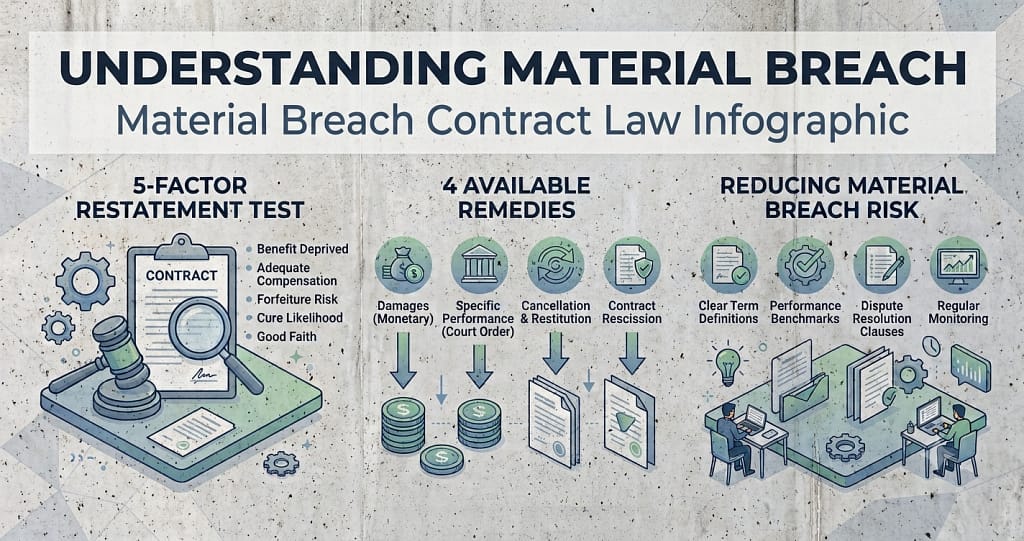
What Is a Material Breach of Contract?
A material breach of contract is a failure so significant that it defeats the contract’s purpose — giving the other party the right to stop performing and sue for damages. Understanding the line between material and minor breach is one of the most consequential distinctions in US contract law.
A material breach of contract is a failure to perform a contractual obligation so significant that it defeats the essential purpose of the agreement. It gives the non-breaching party the right to terminate the contract and sue for damages. US courts apply the five-factor Restatement (Second) of Contracts test to determine whether a breach meets this threshold — and the determination significantly affects what remedies are available and which party is entitled to them. Legal Chain’s AI helps draft contracts that define breach clearly — free at legalcha.in/beta.

The distinction between material and minor breach is not academic — it determines whether the non-breaching party can stop performing their own obligations, or whether doing so would itself constitute a material breach. Courts apply the Restatement five-factor test to resolve this question across all 50 US states. Photo: Unsplash / Claire Anderson
Material Breach vs. Minor Breach: The Critical Distinction
Not every failure to perform a contractual obligation is a material breach. US contract law distinguishes between two categories — and the distinction determines what remedies the non-breaching party has access to.
| Factor | Material breach | Minor breach |
|---|---|---|
| Effect on contract purpose | Defeats the essential purpose of the agreement | Does not defeat the essential purpose |
| Non-breaching party’s obligations | May stop performing their own obligations | Must continue performing their own obligations |
| Right to terminate | Yes — may treat the contract as discharged | No — may not terminate, only sue for damages |
| Right to sue for damages | Yes — full expectation damages available | Yes — damages for the specific loss caused |
| Determined by | Court applying the Restatement five-factor test | Court finding failure does not meet the material threshold |
| Risk of over-reaction | None — termination is legally justified | Stopping performance may itself be a material breach |
The most consequential practical implication is the last row. If a non-breaching party incorrectly characterizes a minor breach as material — and stops performing their own obligations — they may themselves commit a material breach. This is one of the most common sources of contract disputes: one party stops performing in response to what they believe is a material breach, and the court later determines the original breach was minor, making the non-breaching party’s stoppage the actual material breach.
The Five-Factor Restatement Test: How Courts Determine Material Breach
US courts across all 50 states apply the five-factor test from the Restatement (Second) of Contracts to determine whether a specific breach is material. No single factor is determinative — courts weigh all five in the context of the specific contract and the specific failure.
The more the breach deprives the non-breaching party of what they bargained for, the more likely it is material. A vendor who delivers software that does not function at all has deprived the customer of the entire contracted benefit. A vendor who delivers software with a minor bug in a non-critical feature has deprived the customer of a small portion of the contracted benefit. The first is more likely material; the second is more likely minor.
If money damages can adequately compensate the non-breaching party for the loss caused by the breach, courts are less likely to find the breach material. Conversely, if the harm is not easily compensable — for example, when the subject matter is unique, or the breach causes harm that money cannot adequately remedy — the breach is more likely to be found material. This factor weighs toward materiality when damages are difficult to calculate or when the injured party’s business continuity is affected.
A party who has substantially performed — delivering 95% of the contracted scope — is less likely to be found in material breach than a party who has performed nothing. Partial performance weighs against materiality because it signals that the breaching party intended to fulfill the contract, and because the non-breaching party has received substantial value. However, partial performance does not necessarily prevent a finding of material breach where the unperformed portion is the most critical element.
If the breaching party is likely to remedy the failure — has offered to cure, has a history of performance, and the cure is practically feasible — courts are less likely to find the breach material at the time of the non-performance. This factor emphasizes the dynamic nature of breach determination: what may appear material at the moment of breach may be minor if cure is promptly offered and effectively provided. Many contracts include formal cure provisions — typically 30 days — that codify this factor.
A breach resulting from good faith error, unforeseen circumstances, or an honest dispute about interpretation is less likely to be found material than a deliberate, willful, or bad faith failure to perform. Courts consider whether the breaching party acted reasonably under the circumstances — not just whether they performed. A party who fails to perform because they genuinely believe the other party breached first (even if that belief is later found incorrect) is treated differently from a party who deliberately withholds performance without justification.

No single factor determines material breach — courts weigh all five in context. The most consequential outcome of the determination is whether the non-breaching party was legally entitled to stop performing. If they stopped performance based on a minor breach, their stoppage may itself constitute the material breach that the other party then relies on to sue. Photo: Unsplash / Hunters Race
Remedies Available for Material Breach of Contract
The non-breaching party may treat the contract as discharged — stopping their own performance without liability. This remedy is available only for material breach. A party who terminates in response to a minor breach loses this justification and may face a material breach claim for their own non-performance.
The non-breaching party may recover the economic position they would have been in if the contract had been fully performed, minus any costs they saved by not having to perform their own obligations. Expectation damages are the most common remedy and place the non-breaching party in the position they expected to occupy under the contract.
In limited circumstances — primarily real property transactions and contracts for unique or one-of-a-kind items — a court may order the breaching party to perform rather than pay damages. Specific performance is an equitable remedy awarded at the court’s discretion. It is not available where money damages adequately compensate the non-breaching party.
Damages flowing from the breach that were foreseeable at the time of contracting — such as lost profits caused by the breach, or costs incurred to find an alternative supplier. Consequential damages are available only where the contract does not limit or exclude them. Limitation of liability provisions and consequential damages waivers are specifically designed to cap this category of recovery.
How Well-Drafted Contracts Reduce Material Breach Risk
The uncertainty around whether a specific failure constitutes a material breach — and the litigation that follows from that uncertainty — is largely preventable through careful contract drafting. Three provisions reduce material breach risk most effectively.
Define what constitutes material breach in the contract itself
Many well-drafted commercial contracts include a list of specific events that automatically constitute material breach — failure to pay within 30 days of a notice of non-payment, failure to deliver the agreed scope within a specified time, breach of a confidentiality obligation, or insolvency of a party. By defining these events in the contract, the parties remove the need for judicial determination of the threshold in the most common breach scenarios.
Include a cure provision with a defined notice period
A cure provision gives the breaching party a defined period — typically 30 days — to remedy a breach after receiving written notice before the non-breaching party may terminate. Cure provisions reduce the risk that a temporary or correctable failure triggers termination rights. They also create a record of the notice and cure process that clarifies the sequence of events in any subsequent dispute.
Include a dispute resolution process before termination
A dispute resolution provision — requiring the parties to escalate a dispute to senior management, mediation, or a defined review process before exercising termination rights — reduces the likelihood that termination is exercised based on a disputed breach that could be resolved. This provision is particularly valuable where the breach involves a disputed interpretation of the contract’s scope rather than a clear failure to perform.
Legal Chain’s AI generates contracts that include all three of these provisions for any standard commercial agreement and any US jurisdiction. See how AI drafts legally binding contracts and how AI detects hidden contract risks for more on how the drafting process and analysis work together.
“The most expensive contract dispute is the one where both parties had a colorable position — where one party was justified in believing a material breach had occurred, and the other was justified in believing they were performing. Good drafting doesn’t eliminate breach. It eliminates the ambiguity that turns a breach into a dispute about which party was right.”
Frequently Asked Questions
Draft contracts that define breach clearly. Free.
Material breach definitions. Cure provisions with notice periods. Dispute resolution before termination. Generated with jurisdiction-specific law for all 50 US states. No credit card required.
Try Legal Chain TodayDisclaimer
This article is published for general informational purposes only and does not constitute legal advice. Material breach determinations are highly fact-specific and jurisdiction-dependent. Legal Chain is a technology platform and is not a law firm. Use of Legal Chain does not create an attorney-client relationship. If you are involved in or anticipating a contract dispute, consult a licensed attorney in your jurisdiction. Legal Chain currently supports US jurisdictions only.
Discover more from Legal Chain
Subscribe to get the latest posts sent to your email.
Try Legal Chain Free Today
Draft, analyze, and protect your contracts with AI. No credit card required.
View pricing Legal Chain is a technology platform. Not legal advice.
