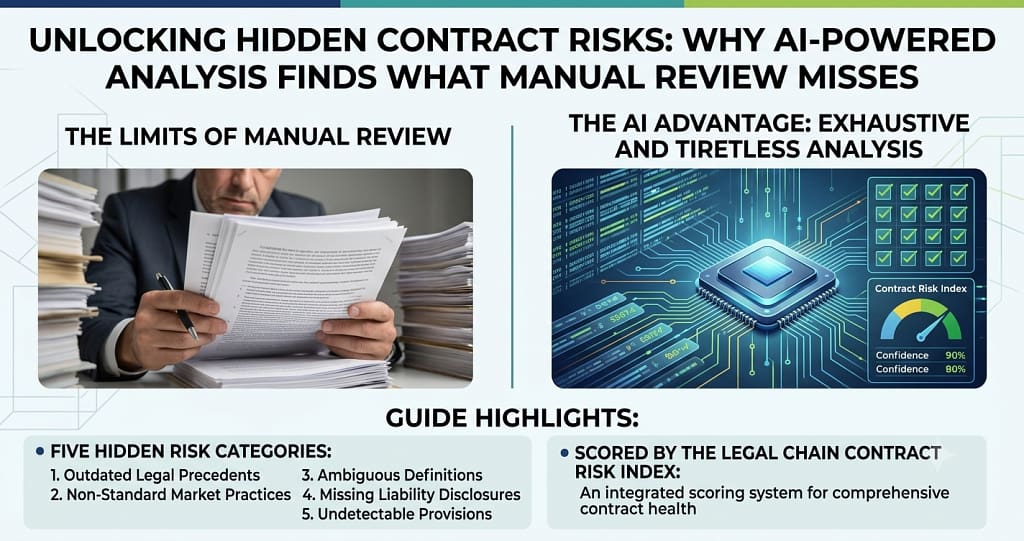
Can AI Detect Hidden Risks in Contracts?
Yes — and it finds specific categories of risk that manual review consistently misses. Not because human reviewers are careless. Because AI does not get tired, does not skip pages, and compares every provision against actual contract data rather than memory.
Key Takeaways
→AI contract risk detection identifies four categories of hidden risk: unexpected liability provisions, compliance gaps, missing standard clauses, and below-market benchmarked terms.
→AI consistently outperforms manual review on missing provision detection — humans focus on what is present, not what should be there but is absent.
→The Legal Chain Contract Risk Index scores every uploaded contract 0–100 against actual market data for the document type and US jurisdiction.
→AI does not detect risks that require legal judgment to identify: strategic implications, ambiguous language interpretation, and novel legal structures.
→Every Legal Chain analysis produces a risk score, flagged provisions with severity ratings, and redline recommendations with replacement language.
Quick Answer
Yes — AI detects hidden contract risks across four specific categories: provisions creating unexpected liability, compliance gaps against applicable state law, missing standard provisions that should be present, and terms benchmarked below market standard for the document type. Legal Chain’s AI analysis produces a Contract Risk Index score benchmarked against actual contract data, along with flagged provisions, severity ratings, and redline recommendations. Try it free at legalcha.in/beta.

Hidden contract risks are not hidden because they use unusual language. They are hidden because they are embedded in standard-looking provisions, appear reasonable in isolation, and create their real impact only when they interact with other provisions or are triggered by specific circumstances. AI finds them systematically. Manual review finds them inconsistently. Photo: Unsplash / Brooke Cagle
The Four Categories of Hidden Contract Risk AI Detects
⚡
Unexpected liability provisions
Critical
Provisions that create financial exposure significantly beyond what the contract’s subject matter would suggest. The most consequential are unlimited indemnification clauses exempted from the contract’s limitation of liability — a combination that strips the liability cap of its protection. AI identifies this pattern systematically by checking whether each indemnification clause is subject to the limitation of liability provision. Manual review often evaluates each clause individually and misses the interaction.
Unlimited indemnification
Personal guarantees
Indemnification + liability cap exemption
Consequential damages exposure
🗓
Auto-renewal and termination traps
High
Provisions that lock a party into extended terms without affirmative action, or that create asymmetric termination rights. Auto-renewal with 60- or 90-day notice windows is the most consistently missed provision in manual contract review — particularly when the signing deadline is close to the notice window date. AI identifies both the renewal term and the notice window, calculates the effective date by which notice must be given, and flags cases where the notice window may have already begun relative to a standard signing timeline.
Auto-renewal with long notice
One-sided termination rights
Evergreen provisions
Exit fee on early termination
📋
Compliance gaps against applicable state law
High
Provisions that are void or unenforceable under the applicable US state’s statutes, or the absence of provisions that state law requires. California non-compete clauses void under BPC 16600. Illinois non-competes below the $75,000 Freedom to Work Act threshold. New York employment agreements missing the Wage Theft Prevention Act notice. California employment agreements missing the Labor Code Section 2870 IP carve-out. AI that applies jurisdiction-specific law identifies these systematically. Generic contract review tools do not.
Void non-competes (CA, IL)
Missing wage disclosures (NY)
AB5 classification risk (CA)
Missing IP carve-outs (CA Lab Code §2870)
🔍
Missing standard provisions
Medium
Standard provisions that should be present for the document type but are absent from the contract. A vendor agreement without a limitation of liability clause leaves one party with unlimited exposure. A software services agreement without a data breach notification provision creates compliance gaps in most US states. A contractor agreement without an IP assignment clause leaves IP ownership ambiguous. AI systematically checks for the standard provision set for each document type and flags what is missing — a task that manual review performs inconsistently because reviewers focus on what is present.
Missing limitation of liability
No data breach notification
Missing IP assignment
No governing law clause
📊
Below-market benchmarked provisions
Medium
Provisions that are technically present but below the market standard for the document type — a liability cap set at one month’s fees when the market standard is 12 months, a payment term of net-90 when the market standard is net-30, an IP assignment that excludes standard carve-outs for background IP. AI identifies these by comparing each provision against benchmarked data for the document type and jurisdiction. Manual review identifies them only if the reviewer has current market data for the specific provision type — which is inconsistent across reviewers and jurisdictions.
Below-market liability cap
Unfavorable payment terms
Below-market IP carve-outs
Non-standard notice periods

The five risk categories above cover the provisions that create the most significant unexpected consequences when signed without detection. Each is found by AI through a different detection mechanism — provision interaction analysis, compliance gap checking, standard provision auditing, and benchmark comparison. Photo: Unsplash / Scott Graham
The Legal Chain Contract Risk Index: How AI Scores Contract Risk
0 – 25
Low
Standard provisions, market-rate terms, no compliance gaps, no missing standard clauses. Review the specific flags; no provisions require immediate attention.
26 – 50
Moderate
One or more provisions below market standard or a minor compliance gap. Review and consider redlining flagged provisions before signing.
51 – 74
High
Significant deviations from market standard or compliance gaps requiring resolution. Redline flagged provisions. Consider attorney review of highest-severity flags.
75 – 100
Critical
Critical provisions — unlimited indemnification, personal guarantee, material compliance failure. Do not sign without attorney review of flagged provisions.
The risk score is calculated from four weighted inputs: provision severity flags (critical, high, medium, low), missing provision penalties, compliance gap severity by applicable state, and benchmark deviation from market standard for the document type and jurisdiction. The score provides a single reference number for comparing contracts within a portfolio and for determining which agreements require attorney involvement alongside AI review.
What AI Does Not Detect: The Risks That Still Require a Lawyer
✕
Strategic implications of specific terms. Whether accepting a particular IP assignment makes strategic sense for a specific business at a specific stage of its development requires business judgment that AI does not provide. AI flags the IP assignment as present and describes what it transfers. The decision about whether to accept, negotiate, or reject it is a judgment call.
✕
Genuinely ambiguous language where both interpretations are plausible. AI can identify that a provision is ambiguous — two reasonable readings are possible. Predicting which interpretation a court in a specific jurisdiction would adopt requires knowledge of local precedent that AI does not reliably possess.
✕
Novel legal structures without established precedent. A contract involving a genuinely new financial instrument, an unprecedented IP arrangement, or a cross-jurisdictional structure with no established standard requires attorney judgment to evaluate the legal implications — not pattern matching against existing contract data.
✕
The negotiation dynamics of a specific counterparty relationship. Which provisions to push back on, which to accept, and how hard to negotiate depends on the commercial relationship, the deal’s importance, and the other party’s likely positions — business and legal judgment that AI does not provide.
“AI detects what is present, what is absent, and how each compares against verified legal standards and market data. These are the systematic tasks. The judgment tasks — what to do about what AI finds, how to negotiate, what matters strategically — remain with the people signing the contract.”
Frequently Asked Questions
Can AI detect hidden risks in contracts?+
Yes — across four specific categories: unexpected liability provisions (unlimited indemnification, personal guarantees, liability cap exemptions); compliance gaps against applicable state law (void non-competes, missing mandatory disclosures, misclassification risk); missing standard provisions (limitation of liability, data breach notification, IP assignment); and below-market benchmarked terms. AI detects these systematically, without fatigue, and benchmarks against actual contract data for the document type and jurisdiction.
What is the Legal Chain Contract Risk Index?+
A 0–100 risk score benchmarked against actual contract data for the same document type and US jurisdiction. Low (0–25): standard provisions, no gaps. Moderate (26–50): minor deviations worth redlining. High (51–74): significant deviations requiring resolution. Critical (75–100): unlimited indemnification, personal guarantee, or material compliance failure — do not sign without attorney review. Every Legal Chain analysis includes the full score with flagged provisions and severity ratings.
What hidden risks does AI find that human reviewers miss?+
AI consistently outperforms manual review in four areas: provision interaction analysis (finding when two individually reasonable provisions combine to create unexpected liability); missing provision detection (humans focus on what is present, AI checks what should be present but is absent); cross-document compliance against jurisdiction-specific statutes; and benchmark deviation from market standard (which requires comparison to actual contract data rather than reviewer memory).
How does Legal Chain calculate a contract risk score?+
Four weighted inputs: provision severity flags (critical = unlimited liability, personal guarantee; high = auto-renewal, one-sided termination; medium = below-market cap, ambiguous IP); missing provision penalties by document type; compliance gaps by jurisdiction and applicable penalty regime; and benchmark deviation from market standard. The score aggregates all findings into a single 0–100 reference number. Try a free analysis at
legalcha.in/beta.
See your contract’s risk score. Free.
Upload any contract. Get the Contract Risk Index score, flagged provisions with severity ratings, compliance gaps by US state, missing provision detection, and redline recommendations — in under five minutes. No credit card required.
Try Legal Chain Today
Disclaimer
This article is published for general informational purposes only and does not constitute legal advice. Legal Chain is a technology platform and is not a law firm. Use of Legal Chain does not create an attorney-client relationship. For contracts with significant financial exposure or complex regulatory requirements, consult a licensed attorney. Legal Chain currently supports US jurisdictions only.