Entire Agreement Clause: What It Means and Why It Matters
The entire agreement clause is boilerplate — but it is boilerplate with significant legal consequences. It determines whether everything said before signing is legally irrelevant to what was agreed. Most signers do not understand this until it is too late.
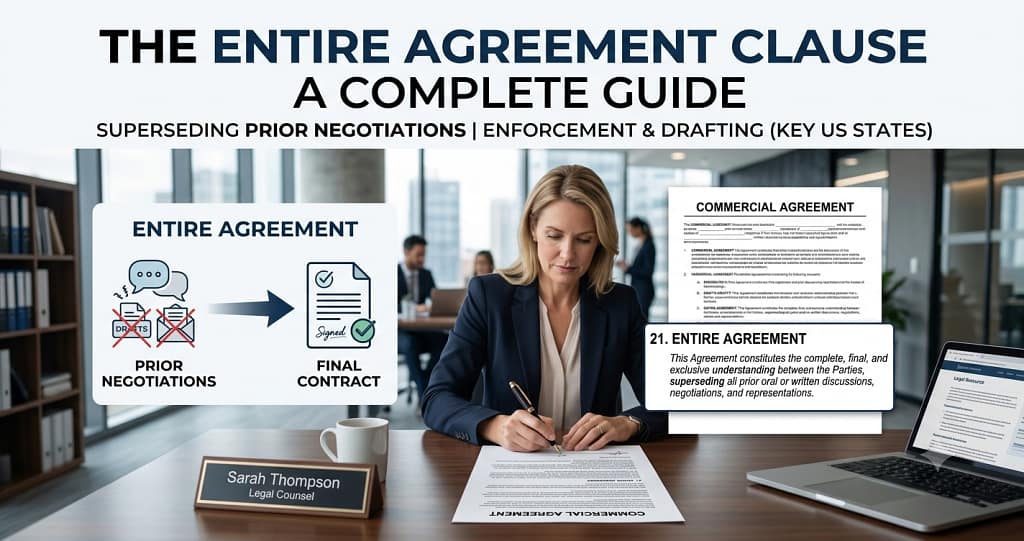
An entire agreement clause — also called an integration clause or merger clause — states that the written contract is the complete and final agreement between the parties, replacing all prior negotiations, representations, and understandings. Its legal effect is to prevent either party from claiming that something said or written before signing modified the contract’s terms. It does not prevent fraud claims, subsequent modifications, or the use of extrinsic evidence to resolve genuine ambiguity. Legal Chain generates contracts with complete boilerplate — free at legalcha.in/beta.

The entire agreement clause typically appears near the end of a contract under “General” or “Miscellaneous” provisions — where most signers stop reading carefully. Its legal effect is one of the most significant of any single provision in the document. Photo: Unsplash / Dan Nelson
What an Entire Agreement Clause Actually Says
The entire agreement clause appears in most commercial contracts under the “General,” “Miscellaneous,” or “Boilerplate” section — typically near the end, where attention is lowest. Its standard form looks like this:
“This Agreement constitutes the entire agreement between the parties with respect to the subject matter hereof and supersedes all prior and contemporaneous agreements, representations, negotiations, and understandings of the parties, whether oral or written, with respect to such subject matter. No modification, amendment, or waiver of any provision of this Agreement shall be effective unless made in writing and signed by authorized representatives of both parties.”
This single paragraph does two things simultaneously. The first sentence is the entire agreement clause proper — it establishes that the written contract is the complete agreement and overrides everything that came before it. The second sentence is a no-oral-modification clause — it prevents future modifications from being made orally. Together, they create a closed system: the written contract governs what was agreed at signing, and only written amendments can change it going forward.
The entire agreement clause has particular significance in the context of pre-contract negotiations. In commercial relationships, parties often negotiate at length before a contract is signed — exchanging emails, term sheets, letters of intent, and verbal commitments. The entire agreement clause means that once the contract is signed, none of those prior communications can be used to modify or supplement the written terms. If it is not in the contract, it is not agreed.
The Parol Evidence Rule: The Legal Doctrine Behind the Entire Agreement Clause
The entire agreement clause gives contractual force to a pre-existing common law principle called the parol evidence rule. Under this rule, a fully integrated written contract — one that the parties intend to represent their complete agreement — cannot be modified, supplemented, or contradicted by evidence of prior or contemporaneous oral or written agreements.
The entire agreement clause signals to a court that the contract is fully integrated — that the parties intended the written document to be the complete expression of their agreement. This signal strengthens the application of the parol evidence rule and makes it more difficult for either party to introduce extrinsic evidence of what was discussed or promised before signing.
Without an entire agreement clause, a court must determine from context whether the written contract was intended to be fully integrated — which introduces uncertainty and opens the door to extrinsic evidence. The entire agreement clause resolves that uncertainty explicitly.
What the Entire Agreement Clause Does — and What It Does Not

The fraud exception to the entire agreement clause is the most significant limitation — and the one most relevant when a party claims they were induced to sign by representations that did not end up in the written contract. The clause eliminates innocent pre-contract misunderstandings; it does not eliminate liability for deliberate deception. Photo: Unsplash / Lukas Blazek
Four Components of a Well-Drafted Entire Agreement Clause
The core of the clause — a clear statement that the written agreement constitutes the entire agreement between the parties with respect to the subject matter. “With respect to the subject matter hereof” is important: it limits the clause’s effect to the subject matter of the specific contract, rather than potentially superseding unrelated agreements between the same parties. Two parties may have multiple agreements — an NDA, a services agreement, and a purchase order — and the entire agreement clause in each should be limited to that agreement’s subject matter.
An explicit statement that the written agreement supersedes all prior and contemporaneous agreements, representations, negotiations, and understandings — whether oral or written. “Contemporaneous” covers agreements made at the same time as the contract being signed; “prior” covers everything before. “Whether oral or written” explicitly includes emails, letters of intent, term sheets, and verbal commitments. The more specific the list of what is superseded, the clearer the clause’s effect in enforcement.
A statement that no modification or amendment to the contract shall be effective unless in writing and signed by authorized representatives of both parties. Without this clause, a party may claim that a subsequent telephone conversation or email exchange orally amended the written contract — and courts in some US states have found such claims viable even where a written agreement existed. The no-oral-modification clause, when clearly stated, forecloses this argument in most jurisdictions.
A statement that no waiver of any provision shall be effective unless made in writing, and that failure to enforce a provision shall not constitute a waiver of the right to enforce it in the future. Without this, a party who fails to enforce a provision in one instance may be found to have waived the right to enforce it in the future — a doctrine called course of dealing. The waiver provision preserves enforcement rights even when a party has been lenient in practice.
Entire Agreement Clause Enforcement Across US States
| State | Enforcement approach | Key jurisdiction-specific consideration |
|---|---|---|
| Delaware | Strongly enforced | Delaware courts give significant weight to entire agreement clauses and are reluctant to allow extrinsic evidence where the clause is present and the contract language is clear. Preferred governing law for integration-sensitive commercial contracts. |
| New York | Strongly enforced | New York courts enforce entire agreement clauses rigorously where the contract is unambiguous. Allow extrinsic evidence only to resolve genuine ambiguity — not to add terms omitted from the written agreement. Fraud exception is recognized. |
| California | Enforced — with broader ambiguity exception | California’s “Pacific Gas & Electric” doctrine allows more liberal use of extrinsic evidence to determine whether contract language is ambiguous than Delaware or New York. California courts may admit evidence of prior negotiations even where an entire agreement clause is present, if the evidence is offered to show the contract language is susceptible to the proffered interpretation. |
| Texas | Strongly enforced | Texas follows the “four corners” rule — courts look primarily to the written contract when determining the parties’ intent, giving significant effect to entire agreement clauses. Extrinsic evidence is limited to cases of genuine ambiguity that cannot be resolved from the contract text alone. |
| Illinois | Enforced | Illinois courts enforce entire agreement clauses as expressions of the parties’ intent to fully integrate their agreement. Fraud exception recognized. Extrinsic evidence to resolve ambiguity permitted where the ambiguity is patent — visible on the face of the contract — rather than latent. |
Why the Entire Agreement Clause Matters More Than It Looks
The most common scenario where the entire agreement clause becomes consequential is a dispute about pre-contract representations. A vendor’s sales team promises features that do not appear in the signed agreement. A landlord verbally agrees to renovation terms that are not in the lease. A founder receives assurances about equity terms that differ from the written SAFE. When the dispute arises, the party relying on the pre-contract representation discovers that the entire agreement clause has superseded it.
The protection runs in both directions. The entire agreement clause also prevents the other party from claiming that pre-contract negotiations included obligations that you did not agree to include in the written contract. If the negotiation included a verbal promise you made that is not in the contract, the entire agreement clause prevents the other party from enforcing that promise — unless they can establish fraud in the inducement.
The practical implication is straightforward: everything that matters must be in the contract. Every commitment made during negotiation that the parties intend to be binding should appear in the written document. Once the contract is signed with an entire agreement clause, the negotiations are legally over — and the written document is the only record of what was agreed.
“The entire agreement clause is the provision that makes the contract the contract — not the negotiation, not the emails, not the term sheet, not what the sales rep said. Once it is signed, the written document is the only thing that matters legally. Make sure it contains everything you negotiated.”
Frequently Asked Questions
Generate contracts with complete, jurisdiction-calibrated boilerplate. Free.
Entire agreement clause. No-oral-modification. Severability. Waiver. Governing law. All standard boilerplate provisions applied correctly for any US state. Any contract type. Under five minutes. No credit card required.
Try Legal Chain TodayDisclaimer
This article is published for general informational purposes only and does not constitute legal advice. Entire agreement clause enforcement varies by jurisdiction and specific contract facts. Legal Chain is a technology platform and is not a law firm. Use of Legal Chain does not create an attorney-client relationship. For contracts with significant legal implications, consult a licensed attorney. Legal Chain currently supports US jurisdictions only.
Discover more from Legal Chain
Subscribe to get the latest posts sent to your email.
Try Legal Chain Free Today
Draft, analyze, and protect your contracts with AI. No credit card required.
View pricing Legal Chain is a technology platform. Not legal advice.
